
Updated on Dec 19, 2025
Author: Dr. Tony Ebel, DC, CPPFC, CCWP
Revised for Inspire Chiropractic by Davis Madole, Reviewed by Dr. Shah Khan DC
Living with sensory processing issues can be overwhelming for both children and families. Take Aria’s story: she often refused unfamiliar places and people, and outings would frequently end in meltdowns due to sensory overload.
With Sensory Processing Disorder (SPD), a child’s nervous system struggles to receive, interpret, and respond appropriately to sensory input. Today, 1 in 6 children experiences sensory challenges, yet many pediatricians simply say, “It’s just a phase.” Early intervention, however, is critical to prevent struggles from becoming long-term issues.
What Exactly is Sensory Processing Disorder?
SPD occurs when children have difficulty processing information from their environment or their own bodies.
Imagine a loud carnival with flashing lights, strong smells, and chaos. For children with SPD, this isn’t exciting—it’s overwhelming. Their nervous system struggles to filter normal input.
SPD can affect any of the senses:
- Auditory: Sensitive to noise or volume
- Visual: Overwhelmed by bright or flickering lights
- Olfactory: Strong smells are bothersome
- Gustatory: Sensitive to textures or tastes
- Tactile: Irritated by fabrics or tags
- Vestibular: Poor balance or coordination
- Proprioceptive: Difficulty sensing body position (crucial for overall neurodevelopment)
SPD often occurs alongside Autism Spectrum Disorder, but children with SPD may have age-appropriate skills in other areas. Unfortunately, traditional pediatric guidance is often limited, leaving parents without answers while their children continue struggling with meltdowns, sleep issues, or picky eating.
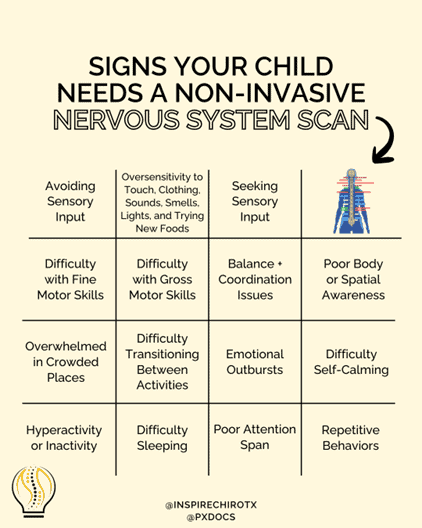
Signs of Sensory Processing Disorder
Children may show hypersensitivity (over-responsiveness) or hyposensitivity (under-responsiveness)—sometimes both.
Oversensitivity (Hypersensitivity):
- Infants: Excessive crying, feeding struggles
- Toddlers/Preschoolers: Strong reactions to textures, sounds, lights, or smells; meltdowns; dislikes unexpected touch
- School-aged Children: Bothered by clothing tags, avoids noisy places, covers eyes/ears
Undersensitivity (Hyposensitivity):
- Toddlers/Preschoolers: Seeks touch or pressure, ignores loud sounds
- School-aged Children: Chews on objects, risk-taking, poor smell awareness
Sensory issues often affect sleep, digestion, immunity, and overall physical health. Early recognition is key to supporting healthy development.
Recognizing Sensory Issues
Persistent reactions—either avoidance or craving—beyond typical developmental expectations warrant evaluation.
Sensory challenges can impact:
- Learning and concentration: Overwhelmed by classroom stimuli
- Social and emotional development: Anxiety, misreading cues, frustration
- Family dynamics: Stress from unpredictable meltdowns
- Physical skills: Coordination deficits, delayed gross motor skills
- Other developmental areas: Speech, language, and cognitive growth
What Causes Sensory Processing Disorder?
SPD often arises from cumulative stressors across early development—what we call the “Perfect Storm.” These may include:
- Prenatal stress or high-risk pregnancy
- Birth trauma or interventions
- Sleep difficulties, colic, or constipation
- Early antibiotics and nutritional gaps
- Environmental toxin exposure
These stressors can overstimulate the sympathetic “fight-or-flight” nervous system, suppressing the parasympathetic “rest-and-digest” system. Chronic imbalance, or dysautonomia, leads to excessive neurological tension—called subluxation—that disrupts sensory processing.
Subluxation, Dysautonomia, And The Vagus Nerve
Understanding SPD requires examining three key factors:
- Subluxation: Tension and interference in the nervous system, affecting sensory signal transmission
- Dysautonomia: Nervous system stuck in stress mode, reducing parasympathetic function
- Vagus Nerve Dysfunction: Low vagal tone impairs digestion, immune function, social engagement, and sensory regulation
Neurologically-focused adjustments release sympathetic tension and stimulate parasympathetic and vagal activity, restoring balance. Over time, children often show improvements in emotional regulation, learning, social skills, and physiological stability.
Chiropractic Care and Sensory Processing Disorder
When Aria began Neurologically-Focused Chiropractic Care, her parents witnessed remarkable changes. She went from frequent meltdowns to happily greeting people, with improved sleep and speech.
We use advanced INSiGHT Scans (thermal, surface EMG, and heart rate variability) to measure subluxation, dysautonomia, and nervous system dysfunction. These scans guide personalized care plans and track progress over time.
Even children already in PT or OT can benefit—addressing subluxation and nervous system imbalance often enhances therapy results, helping children reach milestones faster and improve focus, socialization, and emotional regulation.
Sensory challenges don’t have to define a child’s future. With the right neurological support, children can regain adaptability, thrive developmentally, and families can enjoy a calmer, more connected life.
Request an appointment with us today to get started!
Not local to Inspire? Don’t worry! Visit the PX Docs Directory to find a qualified provider near you. https://pxdocs.com/px-docs/
Original Article: https://pxdocs.com/sensory/recognizing-the-signs-of-sensory-processing-disorder/
PX Docs has established sourcing guidelines and relies on relevant, and credible sources for the data, facts, and expert insights and analysis we reference. You can learn more about our mission, ethics, and how we cite sources in our editorial policy.
SOURCES
- Kong M, Moreno MA. Sensory Processing in Children. JAMA Pediatr. 2018;172(12):1208. doi:10.1001/jamapediatrics.2018.3774
- Schaaf RC, Benevides T, Blanche EI, Brett-Green BA, Burke JP, Cohn ES, Koomar J, Lane SJ, Miller LJ, May-Benson TA, Parham D, Reynolds S, Schoen SA. Parasympathetic functions in children with sensory processing disorder. Front Integr Neurosci. 2010 Mar 9;4:4. doi: 10.3389/fnint.2010.00004. PMID: 20300470; PMCID: PMC2839854.
- May-Benson TA, Koomar JA, Teasdale A. Incidence of pre-, peri-, and post-natal birth and developmental problems of children with sensory processing disorder and children with autism spectrum disorder. Front Integr Neurosci. 2009 Nov 11;3:31. doi: 10.3389/neuro.07.031.2009. PMID: 19936320; PMCID: PMC2779100.
- Blanche EI, Reinoso G, Chang MC, Bodison S. Proprioceptive processing difficulties among children with autism spectrum disorders and developmental disabilities. Am J Occup Ther. 2012 Sep-Oct;66(5):621-4. doi: 10.5014/ajot.2012.004234. PMID: 22917129; PMCID: PMC3754787.