
Updated on Dec 19, 2025
Author: Dr. Tony Ebel, DC, CPPFC, CCWP
Revised for Inspire Chiropractic by Davis Madole, Reviewed by Dr. Shaheryar Khan DC, CACCP
For parents, watching your child struggle with speech delays can be heartbreaking and exhausting. You may notice your child having difficulty expressing their needs, wants, or emotions, which can lead to frustration, behavioral challenges, and social struggles that affect your whole family.
Many children work incredibly hard in speech therapy, yet progress can feel slow or stalled. As a parent, it’s natural to wonder why this is happening and whether there’s something more you could be doing to help.
You are not alone.
Nearly 1 in 12 U.S. children ages 3–17 experience a speech, language, or swallowing disorder. Many families are searching for answers beyond traditional approaches.
The encouraging news is that when we look deeper at the root causes of speech delays—especially within the nervous system—new pathways for progress often emerge.
What are Speech Delays?
Speech delays occur when a child’s communication skills develop more slowly than expected for their age. This often means there is stress or interference within the brain and nervous system affecting development.
Children with speech delays may struggle with:
- Clarity: Speech that is hard to understand
- Sentence formation: Difficulty combining words
- Expression: Trouble communicating thoughts and needs
Some children, including those with Level 3 Autism, may be minimally verbal or nonverbal and rely on alternative communication methods.
In other cases, parents notice regression—a child who was speaking begins to lose words around 18–24 months. This can signal underlying neurological stress that needs further attention.
Speech delays often impact more than communication alone. They can affect emotional regulation, behavior, confidence, social connection, and academic success. That’s why early recognition and addressing root causes are so important.
How Speech Works: A Sequential 3-Step Process
Speech is not just about talking—it’s a complex neurological process that happens in three steps:
- Sensory / Receptive (Input): The brain receives and processes language and sound.
- Integration / Coordination: The brain organizes and interprets that information.
- Output: Signals travel through nerves to the muscles of the mouth, face, and breath to produce speech.
While many assume speech delays are caused by problems with muscle movement (output), the issue often begins upstream—in the brainstem, sensory processing, and nervous system regulation.
Subluxation and nervous system dysfunction—especially involving the brainstem and vagus nerve—can disrupt all three stages. Because traditional providers don’t test for these issues, they’re frequently overlooked.
The Role of Subluxation, Nervous System Dysregulation, and Vagus Nerve Dysfunction in Speech Delays
Speech delays are often linked to neurological stress, including:
Subluxation and Dysautonomia
- Subluxation involves reduced movement and neurological interference.
- Dysautonomia (nervous system imbalance) can affect coordination, motor planning, and muscle tone.
- These issues can disrupt brain–body communication and speech motor control.
Vagus Nerve Dysfunction
- The vagus nerve helps regulate vocal cords, breathing, swallowing, and sensory processing.
- Dysfunction may affect voice quality, clarity, volume, and coordination.
- It also plays a major role in calming the nervous system—important for learning and communication.
When these neurological stressors are addressed, many children experience meaningful improvements alongside speech therapy.
The Role of Gross Motor Delays and Gut Issues in Speech Delays
Speech develops after foundational systems are established, including:
- Nervous system regulation
- Gross motor coordination
- Gut, immune, and hormonal health
If a child’s body is still working hard on these foundations, speech may be delayed. Supporting these systems can free up neurological resources needed for communication, emotional regulation, and learning.
Autism, Regression, and Speech Delay/Nonverbal Challenges
Autism is a multi-system condition that often includes speech and communication challenges. In many cases, early stressors can be found in a child’s history, including:
- Birth trauma and upper cervical subluxation
- High toxic or inflammatory load
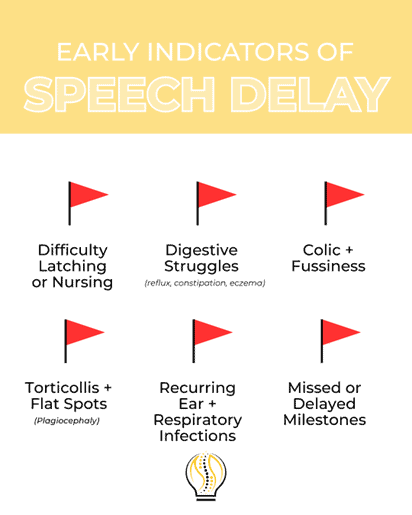
Common early signs—often dismissed as “normal”—may include:
- Difficulty nursing or latching
- Colic, reflux, constipation, or eczema
- Torticollis or plagiocephaly
- Frequent ear or respiratory infections
- Delayed gross motor milestones
Identifying and addressing these early patterns can make a significant difference in a child’s development.
Addressing the Root Cause of Speech Delays
Speech delays are often a sign of deeper nervous system stress—not a lack of effort or ability.
We focus on identifying each child’s unique “Perfect Storm,” including birth stress, neurological interference, and nervous system dysregulation that may be holding back progress.
Through a detailed case history, neurological exam, and INSiGHT Scans, we can identify areas of subluxation and dysfunction. From there, a fully personalized Neurologically-Focused Chiropractic care plan is created to support nervous system regulation and complement speech therapy.
Parents often find that when the nervous system is supported, speech therapy becomes more effective—and children can finally make the progress they’ve been working so hard toward.
Request an appointment with us today to get started!
Not local to Inspire? Don’t worry! Visit the PX Docs Directory to find a qualified provider near you. https://pxdocs.com/px-docs/
Original Article: https://pxdocs.com/speech-delays/understanding-and-addressing-the-root-causes-of-speech-delays-in-children/
PX Docs has established sourcing guidelines and relies on relevant, and credible sources for the data, facts, and expert insights and analysis we reference. You can learn more about our mission, ethics, and how we cite sources in our editorial policy.
SOURCES
- Dorough, Andrew DC. Early intervention: Improvement in motor developmental speech delay in a 2-year-old male following chiropractic care: a case report. Journal of Clinical Chiropractic Pediatrics. Volume 17, No. 2, July 2018
- Ferranti, Melissa, DC, Alcantara, Joel DC. Improvement in Speech & Coordination Following Chiropractic Care in a Child with Developmental Delays and Vertebral Subluxation: Case Report & Review of Literature. Journal of Pediatric, Maternal & Family Health – Chiropractic ~ Volume 2016 ~ Issue 4 ~ Pages 92-98
- Rohde, Jessica F. MD, Goyal, Neera K. MD, MSc, Slovin, Sara R. MD, MSPH, Hossain, Jobayer PhD, Pachter, Lee M. DO, Di Guglielmo, Matthew D. MD, PhD. Association of Positional Plagiocephaly and Developmental Delay Within a Primary Care Network. Journal of Developmental & Behavioral Pediatrics 42(2):p 128-134, February-March 2021. | DOI: 10.1097/DBP.0000000000000860
- Waddington EL, Snider KT, Lockwood MD, Pazdernik VK. Incidence of Somatic Dysfunction in Healthy Newborns. J Am Osteopath Assoc. 2015 Nov;115(11):654-65. doi: 10.7556/jaoa.2015.136. PMID: 26501758.