
Updated on Apr 19, 2026
Author: Dr. Allie Wright
Revised for Inspire Chiropractic by Davis Madole, Reviewed by Dr. Shah Khan DC, CACCP
Nearly 1 in 5 children struggles with a mental, emotional, or behavioral challenge.
If you’ve watched your child go from calm to meltdown in seconds—or noticed how they absorb your stress—you’ve already seen something important:
Their nervous system is connected to yours.
This is called co-regulation.
You may have tried behavior charts, therapy, even medications. But if things still feel off, there’s often a deeper reason:
Your child’s behavior isn’t defiance—it’s dysregulation. And that dysregulation is rooted in the nervous system.
What Is Co-Regulation?
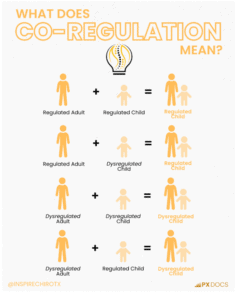
Co-regulation is how a calm, regulated adult helps a child’s nervous system settle.
It’s not just what you say—it’s how your body responds.
Kids learn how to handle stress by borrowing your nervous system. When you stay calm, their brain learns how to return to calm, too.
This happens automatically through things like:
- Breathing patterns
- Muscle tension
- Heart rate
Your child’s system is constantly reading yours.
Signs Your Child Needs Co-Regulation Support
When a child’s nervous system is overwhelmed, it shows up in patterns like:
Physical signs:
- Constant movement or restlessness
- Trouble falling asleep
- Frequent stomachaches or headaches
- Sensory sensitivities
Emotional & behavioral signs:
- Big reactions to small problems
- Meltdowns during routines like homework or mornings
- Quick escalation with siblings
- Difficulty calming down once upset
These aren’t random behaviors—they’re signs of a system under stress.
The “Perfect Storm”: How Dysregulation Develops
At PX Docs, we often see a pattern called the “Perfect Storm”—layers of early stress that shape the nervous system.
Prenatal stress: Stress during pregnancy can influence how a baby’s stress response develops.
Birth stress: Interventions or difficult deliveries can create tension in the upper neck and brainstem—key areas for regulation.
Early childhood challenges: Frequent illness, antibiotics, digestive issues, and environmental stress add more load to the system.
Instead of growing out of it, many kids stay stuck in stress mode.
Understanding the Nervous System Connection
Your nervous system has two main modes:
- Fight-or-flight (gas pedal)
- Rest and regulate (brake pedal)
The vagus nerve helps control that balance.
When it’s working well, you and your child can recover from stress. When it’s not, the body stays stuck in overdrive.
Young brains are still developing rapidly. Every time your child experiences calm, it strengthens their ability to self-regulate.
Measuring What Matters
At Inspire, we start by measuring the nervous system with INSiGHT scans.
These scans show:
- Stress patterns and tension
- Autonomic balance (fight-or-flight vs. regulation)
- Areas of interference affecting communication
They give a clear, objective picture of what’s happening beneath the surface—for both parent and child.
Real Transformation
We often see kids make progress—but then hit a plateau.
That’s when we look at the parent’s nervous system, too.
In many cases, their patterns mirror their child’s.
When parents begin care and become more regulated:
- They can stay calm during tough moments
- Co-regulation improves
- And the child’s progress accelerates
It’s not just about the child—it’s about the system they’re learning from.
Why This Approach Is Different
Traditional approaches often focus on managing behavior.
But behavior is the output—not the root cause.
At Inspire, we focus on:
- Nervous system regulation
- Vagus nerve function
- Reducing interference in communication between brain and body
When regulation improves, behavior often follows.
Strategies That Work (After Regulation Improves)
Once the nervous system is more balanced, these tools become more effective:
- Regulate yourself first: Your calm sets the tone
- Use physical connection: A hand on the shoulder or a hug can help
- Match, then guide: Meet your child where they are, then bring them down
- Talk less during meltdowns: Stay present—teach later
Take Action Today
If your family feels stuck in cycles of stress, it may be time to look at the nervous system.
A visit to Inspire Chiropractic includes:
- A full conversation about your child’s history
- INSiGHT scans to assess nervous system function
- A personalized care plan
- Ongoing tracking of progress
Many families begin to notice changes within the first few weeks.
The Cost of Waiting
When a child’s nervous system stays stuck in stress mode:
- Patterns become more ingrained
- Learning and social challenges build
- Developmental progress slows
But the good news is this:
Kids’ nervous systems are highly adaptable.
With the right support, change can happen faster than most parents expect.
You’re not failing as a parent.
You’ve just been missing a piece of the puzzle.
And when you start addressing the nervous system—everything else can finally start to fall into place.
Request an appointment with us today to get started!
Not local to Inspire? Don’t worry! Visit the PX Docs Directory to find a qualified provider near you. https://pxdocs.com/px-docs/
Original Article: https://pxdocs.com/family-wellness/co-regulation/
PX Docs has established sourcing guidelines and relies on relevant, and credible sources for the data, facts, and expert insights and analysis we reference. You can learn more about our mission, ethics, and how we cite sources in our editorial policy.
SOURCES
- Centers for Disease Control and Prevention. (2025). Data and Statistics on Children’s Mental Health. Retrieved from https://www.cdc.gov/children-mental-health/data-research/index.html
- Dahlitz, M. J., et al. (2021). Recognizing Early Regulation Disorders in Pediatric Care: The For Healthy Offspring Project. Medical Science Monitor, 27. Retrieved from https://pmc.ncbi.nlm.nih.gov/articles/PMC8130504/
- Feldman, R., et al. (2022). Parent-child co-regulation from infancy to adolescence. Developmental Review, 63. Retrieved from https://pmc.ncbi.nlm.nih.gov/articles/PMC11592606/
- Van den Bergh, B. R., et al. (2018). Prenatal developmental origins of behavior and mental health. Neuroscience & Biobehavioral Reviews, 117. Retrieved from https://www.ncbi.nlm.nih.gov/pmc/articles/PMC6237336/
- Center on the Developing Child at Harvard University. (2025). Brain Architecture. Retrieved from https://developingchild.harvard.edu/key-concept/brain-architecture/
- Psychology Today. (2021). Playing Together Synchronizes Mother-Child Autonomic Systems. Retrieved from https://www.psychologytoday.com/us/blog/the-athletes-way/202111/playing-together-synchronizes-mother-child-autonomic-systems