
Updated on Mar 20, 2026
Author: Dr. Tony Ebel, DC, CPPFC, CCWP
Revised for Inspire Chiropractic by Davis Madole, Reviewed by Dr. Shah Khan DC, CACCP
If your child can’t settle down, has frequent meltdowns, or feels overwhelmed by everyday situations, you’re not alone.
Many parents watch their kids cover their ears at loud sounds, struggle through transitions, or lie awake at night with racing thoughts—and wonder if something deeper is going on.
These patterns are often signs of what we call “Busy Brain Syndrome.” And if you’ve already tried behavior charts, diet changes, or sensory tools with little progress, it may be time to look at the real driver:
Your child’s nervous system.
What is Busy Brain Syndrome?
Busy Brain Syndrome means your child’s brain and body are carrying too much stress and stimulation—and can’t slow down.
At the core, this isn’t just behavior. It’s the Autonomic Nervous System (ANS) stuck in overdrive.
Think of the nervous system like this:
- Gas pedal (fight-or-flight)
- Brake pedal (rest and regulate)
Kids with busy brains are stuck with the gas pedal on, while the brake—largely controlled by the vagus nerve—isn’t working well.
This makes their system more sensitive, so everyday inputs feel overwhelming.
This isn’t just a high-energy or creative child. These kids struggle with regulation in a way that affects sleep, learning, and connection.
The Signs: How Busy Brain Shows Up in Kids
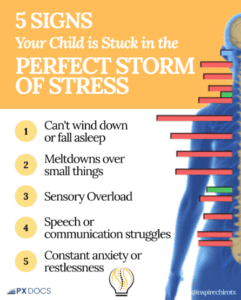
1. Sleep Challenges
One of the most common signs is difficulty sleeping.
You might notice:
- Trouble falling asleep
- Frequent waking
- Racing thoughts at night
- Complaints of headaches or stomachaches at bedtime
Their body is still in “go mode” when it should be winding down. Without a strong brake pedal, they feel exhausted—but can’t shut off.
2. Speech Challenges
Speech and communication require a calm, organized brain.
When a child’s system is overloaded:
- They may struggle to find words
- Have trouble following directions
- Get overwhelmed trying to process and respond
It’s not that they don’t know what to say—their brain just doesn’t have the capacity in that moment.
3. Social and Emotional Challenges
Busy Brain Syndrome often shows up most clearly in emotions and behavior.
You may see:
- Big reactions to small problems
- Frequent meltdowns
- Difficulty with transitions
- Trouble calming down once upset
Behaviorally, they might:
- Constantly move or fidget
- Avoid overwhelming environments
- Seek intense input (crashing, jumping) to self-regulate
These kids aren’t being difficult—their nervous system is overwhelmed.
And when the brain is focused on stress, it prioritizes survival over connection, making social development and emotional regulation much harder.
Busy Brain Syndrome and The “Perfect Storm”
We call the root cause the “Perfect Storm”—a buildup of stress on the nervous system starting early in life.
Prenatal stress:
Stress during pregnancy can shape how a baby’s nervous system develops.
Birth stress:
Even common interventions can create strain on the head, neck, and brainstem—impacting vagus nerve function.
Early childhood stressors:
Colic, sleep struggles, screen exposure, illness, and a fast-paced environment add more load to an already stressed system.
Over time, the brain stays stuck in “busy mode,” missing out on regulation, connection, and proper development.
When Should You Be Concerned?
All kids have big emotions—but there are signs to look deeper.
Consider support if:
- The challenges show up everywhere (home, school, social settings)
- Daily life is being impacted (sleep, learning, relationships)
- You’ve tried multiple approaches with little change
- Others (teachers, therapists, family) are noticing it too
Busy Brain patterns often overlap with ADHD, anxiety, sensory challenges, or autism—but the underlying issue is often nervous system dysregulation.
The Power of Chiropractic and The Vagus Nerve
To help these kids, we have to address the nervous system—especially the vagus nerve.
The vagus nerve is the body’s main “calming” pathway. It helps shift your child out of fight-or-flight into a state where they can sleep, learn, and connect.
When this system isn’t working well—often due to stress or tension in the upper neck—the brain stays stuck in overdrive.
Neurologically-Focused Chiropractic Care works to reduce that interference and restore proper communication.
When the brake pedal starts working again, everything changes:
- Sleep improves
- Emotions stabilize
- Focus increases
- The body can finally regulate
How Do We Know This is Working?
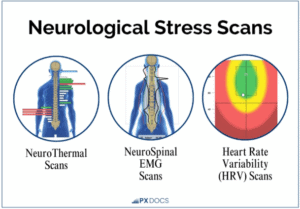
We measure progress using INSiGHT scans.
These scans show:
- Where stress is stored in the nervous system
- How the system is functioning
- Changes over time
This gives families clear, objective insight—not just guesswork.
Why This Matters
When the nervous system is stuck in stress mode, every therapy becomes harder.
But when regulation improves:
- Speech therapy becomes more effective
- OT progresses faster
- Behavioral strategies start to stick
We’re not replacing other care—we’re helping it work better.
Why This is Different
This approach doesn’t mask symptoms.
It focuses on removing interference so your child’s body can regulate the way it’s designed to.
When that happens, kids don’t just cope better—they actually function better.
Next Steps For Parents
If your child is struggling with a busy brain, it’s worth looking at their nervous system.
In the meantime, you can support regulation at home:
- Keep routines predictable
- Give clear transition warnings
- Reduce sensory overload (lights, noise, screens)
- Prioritize sleep
- Build in downtime
- Practice co-regulation—your calm helps their system settle
If you’re working with therapists, that’s great. But when the nervous system is supported first, everything else tends to work better.
Because at the end of the day, this isn’t just about behavior.
It’s about helping your child feel calm, connected, and in control of their world.
Request an appointment with us today to get started!
Not local to Inspire? Don’t worry! Visit the PX Docs Directory to find a qualified provider near you. https://pxdocs.com/px-docs/
Original Article: https://pxdocs.com/behavior/does-your-child-have-a-busy-brain/
PX Docs has established sourcing guidelines and relies on relevant, and credible sources for the data, facts, and expert insights and analysis we reference. You can learn more about our mission, ethics, and how we cite sources in our editorial policy.
- Dahlerup, B. R., Egsmose, E. L., Siersma, V., Mortensen, E. L., Hedegaard, M., Knudsen, L. E., & Mathiesen, L. (2018). Maternal stress and placental function, a study using questionnaires and biomarkers at birth. PMCID: PMC6237336 PMID: 30439989. 13(11):e0207184. https://pmc.ncbi.nlm.nih.gov/articles/PMC6237336/
- Nolvi, S., Merz, E. C., Kataja, E., & Parsons, C. E. (2023). Prenatal Stress and the Developing Brain: Postnatal Environments Promoting Resilience. 15 May 2023, Pages 942-952. https://www.sciencedirect.com/science/article/pii/S0006322322018534
- Paruthi S, Brooks LJ, D’Ambrosio C, Hall WA, Kotagal S, Lloyd RM, Malow BA, Maski K, Nichols C, Quan SF, Rosen CL, Troester MM, Wise MS. (2016). Recommended amount of sleep for pediatric populations: a consensus statement of the American Academy of Sleep Medicine. J Clin Sleep Med 2016;12(6):785–786 https://aasm.org/resources/pdf/pediatricsleepdurationconsensus.pdf