
Updated on May 27, 2026
Author: Dr. Tony Ebel, DC, CPPFC, CCWP
Revised for Inspire Chiropractic by Davis Madole, Reviewed by Dr. Shah Khan DC, CACCP
Have you ever wondered why your child seems to struggle with things that appear to come easily to other kids?
Maybe it’s frequent meltdowns, chronic stomach aches, sensory overload, difficulty sleeping, mood swings, anxiety, or a child who seems to be constantly “on edge.” Sometimes these challenges can feel completely unrelated. But when several of them show up together, parents often begin asking a deeper question:
Could something be going on with my child’s nervous system?
The nervous system is the body’s communication and control network. It influences how we respond to stress, process sensory information, regulate emotions, sleep, digest food, and interact with the world around us.
When that system struggles to adapt appropriately to stress and stimulation, we often use the term nervous system dysregulation to describe the resulting pattern.
At Inspire Chiropractic, we believe understanding the nervous system can help parents better understand what their child may be experiencing — without reducing that child to a diagnosis or a list of symptoms.
In this article, we’ll explore what nervous system dysregulation means, how it can show up in children, factors that may contribute to it, and how families can support healthier nervous system regulation.
What Is Nervous System Dysregulation?
The nervous system includes the brain, spinal cord, and an extensive network of nerves throughout the body. Together, these systems constantly receive information, process it, and coordinate an appropriate response.
A well-regulated nervous system is able to adapt.
It can become more alert when a situation requires attention and settle back down when the stressor has passed.
But when the nervous system has difficulty shifting between these states, a child may spend more time in a heightened state of alertness or, in some situations, appear shut down or disconnected.
This can look very different from child to child.
Some children may become:
- Easily overwhelmed
- Irritable or emotionally reactive
- Hyperactive or constantly moving
- Sensitive to sounds, lights, textures, or touch
- Anxious or fearful
- Easily frustrated
- Resistant to transitions
- Distracted or unable to focus
- Exhausted but unable to settle down
- Withdrawn or unusually quiet
Other children may experience physical challenges alongside these behaviors, including digestive complaints, headaches, sleep difficulties, or changes in energy.
The important thing to understand is that behavior is communication.
Sometimes what looks like defiance, hyperactivity, anxiety, or a “big reaction” may be a child’s nervous system communicating that it is overwhelmed.
What Role Does the Autonomic Nervous System Play?
One of the most important pieces of nervous system regulation is the Autonomic Nervous System (ANS).
The ANS helps regulate functions that happen automatically, including heart rate, breathing, digestion, blood pressure, and many aspects of the body’s response to stress.
It includes two major branches:
1. The Sympathetic Nervous System
The sympathetic nervous system is commonly associated with the body’s fight-or-flight response.
When the brain perceives stress or danger, sympathetic activity can increase heart rate, breathing, muscle tension, and alertness.
This response is incredibly important.
It helps us react when we actually need to react.
The problem isn’t having a stress response.
The problem is when the body has difficulty turning that response down after the threat has passed.
2. The Parasympathetic Nervous System
The parasympathetic nervous system is involved in functions associated with rest, digestion, recovery, and regulation.
One important component of this system is the vagus nerve, which helps connect the brain with organs throughout the body and plays an important role in autonomic regulation.
Think of the nervous system like a vehicle.
The sympathetic system helps provide the gas when your child needs energy, focus, and action.
The parasympathetic system helps provide the brakes when it is time to slow down, recover, and regulate.
Healthy regulation isn’t about eliminating the gas pedal.
It’s about having access to both the gas and the brakes.
Understanding Dysautonomia and Nervous System Regulation
When the autonomic nervous system doesn’t regulate appropriately, the term dysautonomia may be used to describe dysfunction of the autonomic nervous system.
Autonomic dysfunction can involve many different body systems, which is one reason symptoms may appear unrelated.
A child may struggle with sleep, digestion, heart rate regulation, temperature regulation, sensory processing, or emotional regulation at the same time.
That doesn’t necessarily mean there is one single cause behind all of those experiences.
But it does highlight why looking at the nervous system as a whole can be valuable.
What Is Heart Rate Variability?
One measurement frequently used when discussing autonomic nervous system function is Heart Rate Variability (HRV).
HRV refers to the natural variation in time between heartbeats.
Rather than every heartbeat occurring at precisely the same interval, a healthy nervous system naturally makes small adjustments based on breathing, activity, stress, rest, and other factors.
HRV is therefore sometimes used as one window into autonomic function and adaptability.
At Inspire Chiropractic, HRV is one component of our INSiGHT Scanning process.
It’s important to remember that HRV is not a standalone diagnostic test. A single measurement doesn’t tell the entire story about a child’s health.
Instead, it can provide additional information that may help us understand patterns of nervous system function over time.
How Can Nervous System Dysregulation Show Up in Children?
Every child is different, but nervous system dysregulation can appear through a wide range of physical, emotional, sensory, and behavioral patterns.
Emotional Signs
Children may experience:
- Anxiety or excessive worry
- Frequent emotional outbursts
- Irritability
- Difficulty calming down
- Low frustration tolerance
- Rapid mood changes
- Difficulty handling transitions
Behavioral Signs
Parents may notice:
- Hyperactivity
- Impulsivity
- Aggression
- Avoidance
- Social withdrawal
- Difficulty following directions
- Rigidity around routines
- Difficulty transitioning between activities
Sensory Signs
Some children become particularly sensitive to:
- Loud sounds
- Bright lights
- Clothing textures
- Food textures
- Crowded environments
- Physical touch
- Movement or motion
Others may constantly seek additional sensory input through movement, crashing, spinning, jumping, chewing, or touching objects.
Physical Signs
Nervous system regulation can also intersect with physical functions such as:
- Sleep
- Digestion
- Appetite
- Energy
- Breathing
- Heart rate
- Muscle tension
- Headaches
None of these signs automatically means that a child has nervous system dysregulation.
And none should be used to self-diagnose a medical condition.
Instead, they can be signals that deserve a closer look when they are persistent, severe, or interfering with a child’s daily life.
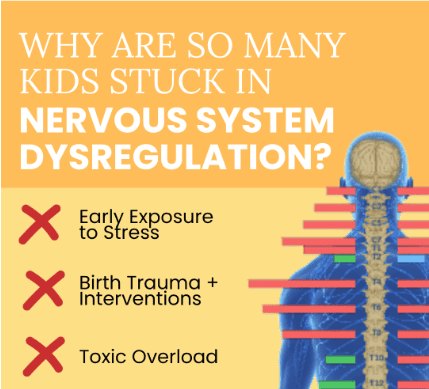
What Can Contribute to Nervous System Dysregulation?
There is rarely one simple answer.
A child’s nervous system develops within the context of genetics, prenatal development, birth, environment, relationships, sleep, nutrition, illness, sensory experiences, and everyday stress.
At Inspire Chiropractic, we often talk with families about the idea of a “Perfect Storm” — not as one specific diagnosis, but as a way of understanding how multiple stressors can accumulate over time.
Prenatal Stress and Development
Pregnancy is a period of rapid neurological development.
Maternal health, stress, nutrition, illness, sleep, and other factors can all influence the prenatal environment.
That doesn’t mean a parent caused their child’s challenges.
Parents deserve support, not blame.
Understanding early developmental factors simply gives us another piece of the larger picture.
Birth and Early Development
Birth is another significant transition for the nervous system.
Some babies experience challenging or highly intervention-heavy births, while others experience relatively uncomplicated deliveries.
Early signs such as difficulty feeding, excessive crying, sleep difficulties, or difficulty settling may sometimes prompt parents to wonder whether their child’s nervous system is having difficulty adapting.
Again, these signs can have many causes and should not automatically be attributed to birth trauma.
Ongoing Stressors
As children grow, they encounter countless physical and environmental stressors.
These may include:
- Illness and infections
- Chronic stress
- Poor sleep
- Sensory overload
- Nutritional challenges
- Excessive screen exposure
- Limited physical activity
- Environmental exposures
- Major changes at home or school
The goal isn’t to create a perfectly stress-free childhood.
That’s impossible.
The goal is to help a child’s nervous system develop the ability to experience stress, adapt, and return toward regulation.
Fight, Flight, Freeze, and Fawn
Children don’t all respond to stress in the same way.
Some become louder.
Some become more active.
Some become quiet.
Some become extremely compliant.
These patterns are sometimes described using four stress responses:
Fight: Anger, aggression, opposition, or intense emotional reactions.
Flight: Restlessness, avoidance, constant movement, or attempts to escape overwhelming situations.
Freeze: Withdrawal, shutting down, appearing “spaced out,” or having difficulty responding.
Fawn: Excessive people-pleasing or prioritizing others’ needs to maintain a sense of safety.
These concepts can provide useful language for understanding stress responses, but they aren’t diagnostic categories.
A child who is quiet isn’t necessarily dysregulated, just as a child who is energetic isn’t necessarily in fight-or-flight.
Context matters.
Can Adults Experience Nervous System Dysregulation?
Absolutely.
Adults can also experience difficulty regulating their response to stress.
They may describe feeling:
- Constantly “on”
- Unable to relax
- Easily overwhelmed
- Chronically tense
- Mentally exhausted
- Anxious
- Sleep deprived
And this matters for families because children learn regulation through relationships.
One of the most powerful forms of support a parent can provide is co-regulation — helping a child move toward calm through the safety, presence, and consistency of a regulated caregiver.
That doesn’t mean parents have to be perfectly calm all the time.
Nobody is.
It simply means that supporting the nervous system is a family process.
Why Looking Beyond the Symptom Can Matter
When a child is struggling, it can be tempting to focus entirely on the behavior in front of us.
“Why won’t they listen?”
“Why can’t they calm down?”
“Why are they so sensitive?”
“Why is bedtime always a battle?”
But sometimes a more useful question is:
“What is their nervous system experiencing right now?”
That shift doesn’t excuse difficult behavior.
It creates an opportunity to understand it.
And understanding can help parents respond with more effective strategies rather than simply escalating consequences.
The Inspire Approach
At Inspire Chiropractic, we take a neurologically focused approach to pediatric chiropractic care.
Our goal isn’t to diagnose or cure nervous system dysregulation.
Instead, we focus on assessing the relationship between the spine, nervous system, and the body’s ability to adapt.
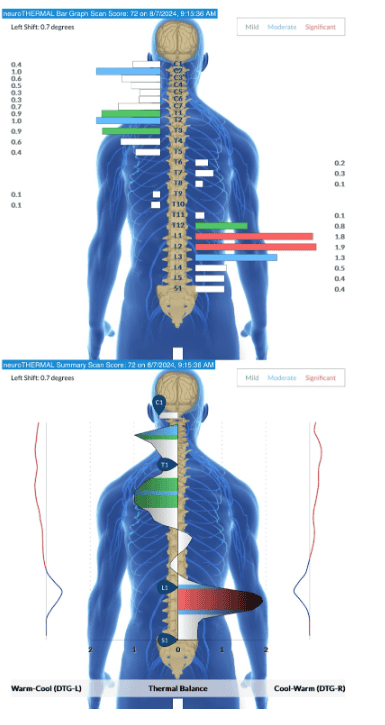
We use INSiGHT Scanning Technology as part of our neurological assessment process.
Depending on the child’s needs, this may include:
- NeuroThermal Scanning to identify patterns of temperature variation along the spine
- Surface EMG to assess patterns of muscle tension
- Heart Rate Variability (HRV) to provide information about autonomic function
These measurements are not intended to diagnose medical conditions.
They provide additional information that can help us understand neurological patterns and track changes over time.
From there, we develop an individualized care plan based on the child’s presentation and needs.
Our care is gentle, specific, and designed with children in mind.
What Can Parents Do at Home?
Professional care is only one piece of the puzzle.
There are also simple ways parents can support regulation at home.
Create Predictability
Predictable routines can help children know what to expect.
Consistent morning, mealtime, and bedtime routines can reduce unnecessary stress and make transitions easier.
Encourage Movement
Movement is a natural part of childhood.
Walking, playing outside, climbing, swimming, running, and other enjoyable activities can provide valuable sensory and physical input.
The goal isn’t always intense exercise.
Sometimes the most regulating activity is simply play.
Practice Slow Breathing
Age-appropriate slow breathing can help children practice shifting toward a calmer state.
For younger children, try having them place a stuffed animal on their belly and slowly breathe in and out while watching it rise and fall.
Keep it playful rather than turning it into another task they have to “perform.”
Prioritize Sleep
Sleep plays an important role in physical and neurological health.
A predictable bedtime routine, consistent sleep schedule, a comfortable sleep environment, and reduced evening stimulation can all support healthier sleep habits.
Focus on Co-Regulation
Perhaps most importantly:
Regulate yourself before trying to regulate your child.
When your child is overwhelmed, lowering your voice, slowing your breathing, getting down to their level, and providing a sense of safety can communicate more than a long explanation ever could.
You don’t have to be a perfect parent.
You just have to keep showing up.
Your Child Isn’t Giving You a Hard Time. They May Be Having a Hard Time.
When a child’s nervous system is overwhelmed, their behavior can become the loudest expression of something happening underneath the surface.
That doesn’t mean every behavior has a neurological explanation.
It doesn’t mean every symptom comes from the nervous system.
And it doesn’t mean parents need to chase a single “root cause” for every challenge.
It means that sometimes, looking at the whole child can reveal important pieces of the picture that aren’t obvious when we focus only on the symptom.
If your child is struggling with regulation, sleep, sensory challenges, behavior, or other concerns, you don’t have to navigate that journey alone.
At Inspire Chiropractic, we’re here to listen, assess, educate, and help you better understand your child’s nervous system.
Because when you understand the nervous system, you can begin to understand the child behind the symptoms.
Not local to Inspire? Don’t worry! Visit the PX Docs Directory to find a qualified provider near you. https://pxdocs.com/px-docs/
Original Article: https://pxdocs.com/nervous-system/nervous-system-dysregulation/
PX Docs has established sourcing guidelines and relies on relevant, and credible sources for the data, facts, and expert insights and analysis we reference. You can learn more about our mission, ethics, and how we cite sources in our editorial policy.
SOURCES
- Centers for Disease Control and Prevention. (2024). Autism prevalence and characteristics among children aged 8 years — Autism and Developmental Disabilities Monitoring Network. MMWR Surveillance Summaries, 72(2), 1-14. https://www.cdc.gov/mmwr/volumes/72/ss/ss7202a1.htm
- Frasch, M. G., et al. (2023). Autonomic nervous system dysregulation and pediatric neurodevelopmental conditions. Frontiers in Psychiatry, 14, 1336040. https://www.frontiersin.org/journals/psychiatry/articles/10.3389/fpsyt.2023.1336040/full
- Kim, S., et al. (2024). Antibiotics and the pediatric gut microbiome: Emerging implications for health and disease. Clinical Nutrition Open Science, 53, 100090. https://www.sciencedirect.com/science/article/pii/S2590097824000090
- Kozlowska, K., et al. (2018). Wired for threat: Clinical features of nervous system dysregulation in 80 children. Journal of Child Neurology, 33(12), 792-799. https://www.sciencedirect.com/science/article/abs/pii/S0887899418302716
- Koenig, J., et al. (2017). Resting state vagal tone in attention deficit (hyperactivity) disorder: A meta-analysis. Neuroscience & Biobehavioral Reviews, 82, 210-217. https://www.sciencedirect.com/science/article/abs/pii/S0149763418308005
- Licht, C. M., et al. (2021). Heart rate variability and autonomic dysfunction in neurological disorders. BMC Neurology, 21(1), 1-10. https://pmc.ncbi.nlm.nih.gov/articles/PMC8465800/
- Porges, S. W. (2022). Polyvagal Theory: A science of safety. Frontiers in Integrative Neuroscience, 16, 871227. https://pmc.ncbi.nlm.nih.gov/articles/PMC9131189/
- Thapa, R., et al. (2022). Reduced heart rate variability in adults with autism spectrum disorder. Autism Research, 15(12), 2325-2340. https://pmc.ncbi.nlm.nih.gov/articles/PMC8964964/
- Zhu, J., et al. (2021). Birth interventions and neonatal outcomes: A systematic review. Current Psychology, 41, 5078-5092. https://www.sciencedirect.com/science/article/pii/S2352289521001338
- Harvard Health and Publishing. (2020). Exercising to relax. https://www.health.harvard.edu/healthy-aging-and-longevity/exercising-to-relax