
Updated on May 18, 2026
Author: Dr. Morgan Reimer
Revised for Inspire Chiropractic by Davis Madole, Reviewed by Dr. Shah Khan DC, CACCP
You know every diagnosis. Every therapy schedule. Every food sensitivity. You have the binders, the spreadsheets, the late-night research tabs still open. You can quote your child’s IEP from memory and recite the dosing schedule of three different supplements without blinking.
But here’s the question almost no one is brave enough to ask you out loud: how are you actually doing?
If your shoulders just dropped a little reading that, this article is for you. Not for your child. Not for your child’s care team. For you, the parent who’s been carrying everything, holding it all together in public, and quietly falling apart in private. What you’re feeling isn’t burnout in the pop-psychology sense, and it isn’t a willpower problem. It’s a nervous system that’s been worn down by years of stress, and it has a name, a biology, and a path forward.
This piece walks through why your nervous system matters so much to your child’s healing journey, why “self-care” tips have never been enough to fix it, and what real, neurological co-care looks like.
The Question No One Asks
The entire pediatric medical system is built around the child. So is the therapy world. So is the school system. Specialists, evaluators, case managers, teachers, and IEP coordinators—every adult in the room is looking past you to your child.
That’s understandable. Kids are the reason everyone’s gathered.
But it leaves the most important person in your child’s healing environment completely unseen. You.
Most parents we work with at Inspire Chiropractic haven’t been asked “how are you doing?” in years, not really. Not in a way that left enough silence for the truth to come out. And the moment someone finally pulls up a chair, leans in, and asks twice, most parents start crying before they finish the first sentence.
That’s a nervous system that’s been holding stress in survival mode for so long, it doesn’t remember what safety feels like.
Parents Have a Perfect Storm Too
At Inspire Chiropractic, we talk a lot about “The Perfect Storm”—the stacking of stressors that overwhelms a child’s developing nervous system and sets the stage for the diagnoses families eventually receive.
Parents have their own “Perfect Storm.”
Yours probably started long before your child was born. Maybe a stressful pregnancy. A traumatic birth of your own. A childhood that didn’t feel safe. A toxic college or early-adulthood season that drained you in ways you didn’t fully process.
Then your child arrived, and the layers kept stacking:
- Sleepless newborn months that became sleepless toddler years
- The first specialist visit that didn’t go the way you hoped
- The diagnosis appointment that changed the trajectory of your family overnight
- IEP fights, insurance denials, prior authorizations, financial strain
- Family members who didn’t understand
- Pediatricians who dismissed you
- Therapists who blamed you
- A community that grew quieter as your needs grew louder
Each of those wasn’t just an emotionally hard moment. Each one was a neurological hit. A stressor that asks your nervous system to fire up, hold tension, scan for threat, defend, advocate, and push through. Layer by layer, year after year, your own “Perfect Storm” built itself underneath you while you were too busy fighting for your child to notice.
This isn’t blame. It’s biology. And once you see it, it changes what “support” actually looks like for you.
Wound Up and Worn Out: What Burnout Really Is
Most articles describe parent burnout as exhaustion plus irritability plus low motivation, then hand you a list of breathing exercises and a referral to therapy.
That’s not wrong. It’s just incomplete.
Parental burnout itself is real and measurable. A 42-country study published in Affective Science documented its prevalence across cultures and confirmed it’s clinically distinct from ordinary parenting stress. What that body of research describes from the outside, we see from the inside, in the nervous system.
What’s actually happening in your body is what we call “wound up and worn out”: a nervous system stuck in two places at once. Your gas pedal (sympathetic, fight-or-flight) is jammed down. Your brake pedal (parasympathetic, rest-and-digest) is offline or barely working. So you’re simultaneously over-activated and depleted.
That dual state is why none of the usual fixes hold.
You can’t sleep, but you’re constantly tired. You drink coffee to function and then can’t wind down at night. Your jaw clenches all day. Your shoulders live up by your ears. Your gut is a mess, no matter how clean you eat. You snap at your kids, then spiral with guilt about snapping. You feel anxious for no reason and numb for no reason, sometimes in the same hour.
This isn’t 10 separate problems. It’s one system, your Autonomic Nervous System, stuck in sympathetic dominance with a vagus nerve that can’t get a word in edgewise.
And it’s why the “drink more water, take a bath, get a babysitter for a date night” advice has never fully worked. You’re not low on bath bombs. You’re neurologically dysregulated.
Your Nervous System Is Part of Your Child’s Environment
Here’s the part of this conversation that changes everything for most parents, and it’s why this isn’t selfish to talk about.
Children don’t heal in isolation. They heal in the context of their environment. The food they eat, the air they breathe, the routines they follow, the people who love them—all of it shapes the conditions under which their nervous system either calms down or stays activated.
The most powerful single signal in that environment is you.
The brainstem and Autonomic Nervous System are constantly scanning for cues of safety or threat. This process, known as neuroception, is running 24/7 underneath conscious awareness.
For a child whose nervous system is already wound up, the most influential source of those cues is the parent standing next to them.
What Co-Regulation Actually Is
Most parents have heard the word “co-regulation,” but it tends to get filed under parenting strategies.
Co-regulation is a neurobiological reality.
Before a child can self-regulate, they have to borrow regulation from a caregiver. Calm parent → calm child. Over thousands of repetitions, the child’s nervous system learns what regulation feels like.
Research on the polyvagal framework shows that vagal tone and autonomic state directly influence social engagement and regulation. When a caregiver’s system is regulated, their voice, facial expression, and breathing become cues of safety. The child’s nervous system uses that as a template.
When the caregiver is stuck in chronic stress, those cues change—even if the parent is doing everything “right” on the surface.
It’s not your fault. It’s physiology. And it’s also the lever.
This Is Not Self-Care. This Is Co-Care.
Self-care, as it’s been sold to parents, has been mostly bath salts and Target runs. Nice. Not regulating.
What you actually need is co-care.
Co-care means healing your own nervous system as part of your child’s healing environment. Not separately. Not eventually. As part of the same system.
Concretely, co-care looks like:
Getting your own nervous system assessed objectively, not just self-reported
Identifying where your subluxation and dysautonomia patterns are stuck
Getting on a real, individualized care plan designed for your nervous system
Tracking objective neurological change over time
Treating regulation as infrastructure for the whole family
It’s important to note that our INSiGHT scanning technology does not diagnose medical conditions, and Neurologically-Focused Chiropractic Care is not a treatment or cure for parental burnout or any condition, including back pain. Instead, INSiGHT scans help identify patterns of nervous system dysfunction so care can be directed toward improving regulation and resilience.
For most parents, it is the first time anyone has ever objectively examined their nervous system.
What the Parents’ Scan Usually Shows
We don’t guess. We test.
INSiGHT scans use heart rate variability (HRV), surface EMG, and thermal scanning to map autonomic function.
In “wound up and worn out” parents, patterns often include:
- HRV stuck in stress dominance
- Chronic upper cervical and shoulder tension patterns on sEMG
- Thermal dysregulation indicating autonomic imbalance
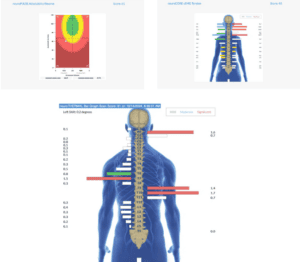
That’s not a personality profile. That’s a physiological snapshot of a system that’s been under load for too long without recovery.
And the good news is that these patterns are measurable in both directions—stress and recovery.
What Changes When the Parent Gets Adjusted
When a parent finally begins receiving Neurologically-Focused Chiropractic Care themselves, we consistently see shifts like:
- Deeper sleep and better recovery
- Less background anxiety
- Reduced tension headaches and jaw pain
- More patience in moments that used to escalate
- More stable energy throughout the day
And in their children:
- Smoother transitions
- Fewer power struggles
- Faster emotional recovery
- Improved sleep
- A calmer household dynamic
Same child. Same environment. Different nervous system signal in the parent.
Permission to Be Cared For
If you’ve made it this far, here’s what your nervous system probably needs to hear:
Caring for your own nervous system is not selfish. It may be one of the most impactful things you can do for your child’s healing.
You are not the problem. You are part of the system that can heal.
Your Next Step
You’ve been fighting for your child for years. It’s time to let someone fight for you, too.
Request an appointment with us today to get started! We can scan, assess, and care for parents the same way they care for kids. Get your own INSiGHT scans done. See your patterns objectively. Start a real, individualized care plan designed for your nervous system, not somebody else’s protocol.
You don’t have to wait until you collapse. You don’t have to wait until your child is fully healed. Your healing and your child’s healing can happen alongside each other—and clinically, that’s often when the biggest shifts happen.
You’ve been the parent no one checked on. Let that end here.
Not local to Inspire? Don’t worry! Visit the PX Docs Directory to find a qualified provider near you. https://pxdocs.com/px-docs/
Original Article: https://pxdocs.com/mental-health/the-parent-no-one-checked-on/
PX Docs has established sourcing guidelines and relies on relevant, and credible sources for the data, facts, and expert insights and analysis we reference. You can learn more about our mission, ethics, and how we cite sources in our editorial policy.
SOURCES
- Roskam, I., Aguiar, J., Akgun, E., Arikan, G., Artavia, M., Avalosse, H., Aunola, K., Bader, M., Bahati, C., Barham, E. J., Besson, E., Beyers, W., Boujut, E., Brianda, M. E., Brytek-Matera, A., Carbonneau, N., César, F., Chen, B. B., Dorard, G., Dos Santos Elias, L. C., … Mikolajczak, M. (2021). Parental Burnout Around the Globe: a 42-Country Study. Affective science, 2(1), 58–79. https://doi.org/10.1007/s42761-020-00028-4
- Porges SW (2022) Polyvagal Theory: A Science of Safety. Front. Integr. Neurosci. 16:871227. doi: 10.3389/fnint.2022.871227 https://www.frontiersin.org/journals/integrative-neuroscience/articles/10.3389/fnint.2022.871227/
- Porges S. W. (2025). Polyvagal Theory: Current Status, Clinical Applications, and Future Directions. Clinical neuropsychiatry, 22(3), 169–184. https://doi.org/10.36131/cnfioritieditore20250301