
Updated on Feb 27, 2026
Author: Dr. Allie Wright
Revised for Inspire Chiropractic by Davis Madole, Reviewed by Dr. Shah Khan DC, CACCP
Before We Begin
Here’s something many parents are never told: the modern American pregnancy experience — filled with constant monitoring, testing, interventions, and fear-based messaging — can create chronic prenatal stress.
And that stress doesn’t just affect mom. A mother’s nervous system directly influences her baby’s developing nervous system.
Before going further, this is important: this is never about guilt. You made the best decisions with the information you had at the time. Many of us have walked this same path. The goal now is understanding — so families can better support their children moving forward.
The Modern Pregnancy Reality Nobody Talks About
Pregnancy today looks very different than it did generations ago.
Where previous generations attended only a handful of prenatal visits, modern moms often experience 12–15 appointments, repeated ultrasounds, bloodwork, screenings, and ongoing monitoring. While many medical advances are lifesaving and necessary in certain situations, pregnancy is increasingly treated like a medical condition instead of a natural physiological process.
Each appointment, test result, or “let’s keep an eye on this” conversation can signal danger to the nervous system. Over time, this creates ongoing stress activation rather than the calm, regulated state pregnancy ideally requires.
Stress impacts more than emotions — it influences the autonomic nervous system, hormone balance, and the baby’s neurological development.
The Trimester-by-Trimester Timeline: What You Actually Experience
First Trimester (Weeks 1–13): The Foundation Is Set
Early pregnancy brings exhaustion, nausea, hormonal shifts, and massive physical change as the body builds the placenta and supports early development.
During this same time, medical visits often include confirmation ultrasounds, extensive blood testing, genetic screening discussions, and long lists of precautions. Each test introduces waiting periods and uncertainty.
That constant anticipation keeps the nervous system activated, increasing cortisol levels during one of the most critical stages of fetal brain development.
Second Trimester (Weeks 14–27): The “Easy” Phase That Isn’t Always Easy
Although energy may improve, physical and emotional demands continue to grow. Routine appointments monitor weight, blood pressure, fetal growth, and development.
The anatomy scan — while exciting — often carries anxiety as parents wait silently for reassurance everything is normal. Glucose testing, additional screenings, or high-risk labels may add further stress and monitoring.
By this stage, many mothers feel they are being closely evaluated at every visit, reinforcing a message that something could go wrong.
Third Trimester (Weeks 28–40+): The Final Stretch
Late pregnancy brings physical discomfort, poor sleep, and increasing anticipation about labor.
Appointments become more frequent, monitoring intensifies, and conversations often shift toward timelines, interventions, or induction planning. Weekly visits, testing, and constant questions about labor can leave many moms feeling overwhelmed and on high alert.
During this final stage of rapid brain development, maternal stress signals continue crossing the placenta to baby.
Special Circumstances: When the Intervention Load Multiplies
Certain situations naturally increase monitoring and stress levels, including:
- High-risk pregnancies
- Multiples (twins or more)
- IVF or fertility journeys
- Pregnancy after loss
- Maternal age over 35
In these cases, medical oversight may be necessary — but the nervous system impact often goes unaddressed. Extended periods in fight-or-flight mode can shape how a baby’s nervous system adapts before birth.
The Biology of Maternal Stress: What’s Really Happening
Stress during pregnancy is biological, not just emotional.
When stress occurs, the body activates the HPA axis, releasing cortisol. While short bursts are normal, chronic activation overwhelms protective mechanisms within the placenta, allowing stress hormones to reach the developing baby.
Your Autonomic Nervous System: The Gas and Brake Pedals
The nervous system operates through balance:
Sympathetic (“Gas Pedal”)
- Fight-or-flight response
- Increased heart rate and vigilance
- Reduced digestion and recovery
Parasympathetic (“Brake Pedal”)
- Rest, digestion, healing, and growth
- Optimal environment for fetal development
Pregnancy ideally favors parasympathetic dominance. Chronic stress keeps the gas pedal pressed, signaling danger rather than safety to both mother and baby.
The Umbilical Cord: More Than Nutrient Delivery
The umbilical cord delivers oxygen and nutrients — but it also carries hormonal signals.
A mother’s nervous system state communicates continuously with her baby. When stress hormones remain elevated, the baby’s developing nervous system adapts to that environment, establishing stress reactivity as its baseline.
This isn’t genetics. It’s neurological programming during development.
What’s Being Programmed in Your Baby’s Brain
During pregnancy, key brain systems responsible for regulation are forming.
Chronic prenatal stress may influence:
- Emotional regulation centers
- Learning and memory pathways
- Executive function development
- Vagus nerve tone
- Neurotransmitter balance
These changes can later appear as challenges with sleep, digestion, sensory processing, attention, or emotional regulation.
The Research That Confirms This
Research following mothers and children has shown measurable differences in babies exposed to higher prenatal stress, including increased stress reactivity and reduced self-regulation early in life.
These findings help explain why some children appear more sensitive, reactive, or difficult to soothe from the very beginning.
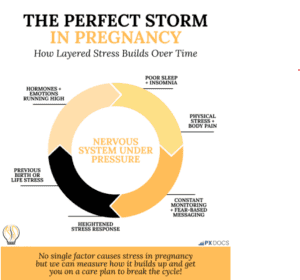
The Perfect Storm: Stage 1 Begins Before Birth
We describe many childhood challenges as part of a Perfect Storm — accumulated stress during critical developmental windows.
Stage 1 begins during pregnancy, when prenatal stress influences nervous system development.
Additional stages may include:
- Birth stress or trauma
- Early childhood stressors or environmental challenges
Each layer adds load to a developing nervous system.
Recognizing the Signs: What This Looks Like
During Pregnancy
Indicators of increased stress load may include:
- Persistent anxiety or poor sleep
- High-risk classification
- Frequent monitoring or interventions
- Difficulty relaxing or feeling safe during pregnancy
After Birth
Babies affected by prenatal stress may show:
- Difficulty feeding or latching
- Excessive crying or tension
- Sleep challenges
- Reflux or digestive issues
- Sensitivity to stimulation
As children grow, these patterns may evolve into behavioral, sensory, immune, or attention challenges rather than disappearing entirely.
The Progression Pattern
Nervous system dysregulation often changes appearance over time:
Colic → digestive challenges → sensory sensitivities → attention or anxiety concerns.
The underlying neurology remains the same — only the diagnosis changes.
What You Can Do: During Pregnancy and After
If You’re Currently Pregnant
Awareness allows change.
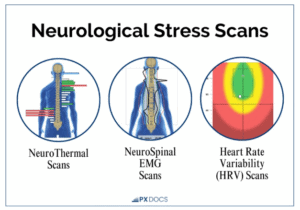
Supporting nervous system regulation during pregnancy may include stress reduction strategies and Neurologically-Focused Prenatal Chiropractic Care aimed at improving autonomic balance and vagal tone.
Parents can also advocate confidently within medical care by asking questions, understanding necessity, and choosing providers who support calm, informed decision-making.
If Your Baby Has Already Been Born
It is not too late.
Children’s nervous systems are highly adaptable. With proper support, regulation and healing are possible.
Neurologically-Focused Chiropractic Care aims to address:
- Subluxation and neurological interference
- Sympathetic dominance
- Poor vagal tone
- Brain-body communication challenges
When nervous system function improves, sleep, digestion, emotional regulation, immune function, and development often improve alongside it.
Why This Works When Other Approaches Haven’t
Many therapies help symptoms, but lasting progress depends on nervous system regulation.
If the body remains stuck in fight-or-flight mode, it struggles to:
- Digest nutrients
- Sleep deeply
- Regulate emotions
- Heal or adapt efficiently
Addressing neurological function first helps other therapies work more effectively.
The Order Matters
Families often try everything before addressing nervous system function.
A more effective sequence is:
- Restore nervous system regulation
- Add nutrition, therapies, and lifestyle supports
- Build progress on a stable foundation
Your Next Step
Whether you are currently pregnant or supporting a child whose progress has stalled, understanding nervous system development provides clarity and direction.
The Perfect Storm may begin before birth — but healing begins by addressing the nervous system itself. Request an appointment with us today to get started!
Not local to Inspire? Don’t worry! Visit the PX Docs Directory to find a qualified provider near you. https://pxdocs.com/px-docs/
Original Article: https://pxdocs.com/pregnancy/the-perfect-storm-in-pregnancy/
PX Docs has established sourcing guidelines and relies on relevant, and credible sources for the data, facts, and expert insights and analysis we reference. You can learn more about our mission, ethics, and how we cite sources in our editorial policy.
- Davis, E. P., & Sandman, C. A. (2010). The timing of prenatal exposure to maternal cortisol and psychosocial stress is associated with human infant cognitive development. Child Development, 81(1), 131-148. https://pmc.ncbi.nlm.nih.gov/articles/PMC2846100/
- Development and Psychopathology. (2017). Effects of pre- and postnatal maternal stress on infant temperament and autonomic nervous system reactivity and regulation in a diverse, low-income population. https://www.cambridge.org/core/journals/development-and-psychopathology/article/effects-of-pre-and-postnatal-maternal-stress-on-infant-temperament-and-autonomic-nervous-system-reactivity-and-regulation-in-a-diverse-lowincome-population/D99A544835C9E33E91D2A66066AAD7DE
- Glover, V. (2020). Prenatal stress: Effects on fetal and child brain development. International Review of Neurobiology, 150, 191-201. https://pubmed.ncbi.nlm.nih.gov/32204831/
- Maternal cortisol over the course of pregnancy and subsequent child amygdala and hippocampus volumes and affective problems. (2012). Proceedings of the National Academy of Sciences, 109(20), E1312-E1319. https://www.pnas.org/doi/10.1073/pnas.1201295109
- Prenatal stress, hormones, and fetal brain development: gender differences. (2025). Hormones. https://link.springer.com/article/10.1007/s42000-025-00696-6
- Seth, S., Lewis, A. J., Saffery, R., Lappas, M., & Galbally, M. (2015). Maternal prenatal mental health and placental 11β-HSD2 gene expression: Initial findings from the Mercy Pregnancy and Emotional Wellbeing Study. International Journal of Molecular Sciences, 16(11), 27482-27496. https://pmc.ncbi.nlm.nih.gov/articles/PMC4661892/
- Xiong, F., & Zhang, L. (2013). Role of the hypothalamic-pituitary-adrenal axis in developmental programming of health and disease. Frontiers in Neuroendocrinology, 34(1), 27-46. https://pmc.ncbi.nlm.nih.gov/articles/PMC3594480/
- Jensen Peña, C., Monk, C., & Champagne, F. A. (2012). Epigenetic effects of prenatal stress on 11β-hydroxysteroid dehydrogenase-2 in the placenta and fetal brain. PLOS ONE, 7(6), e39791. https://pmc.ncbi.nlm.nih.gov/articles/PMC3383683/
- Paquette, A. G., Shynlova, O., Kibschull, M., Price, N. D., & Lye, S. J. (2021). Maternal stress, placental 11β-hydroxysteroid dehydrogenase type 2, and infant HPA axis development in humans: Psychosocial and physiological pathways. Placenta, 104, 179-187. https://pmc.ncbi.nlm.nih.gov/articles/PMC7906936/
- Togher, K. L., et al. (2017). Placental 11 β-hydroxysteroid dehydrogenase type 2 (11β-HSD2) expression very early during human pregnancy. The Journal of Clinical Endocrinology & Metabolism, 102(6), 1846-1854. https://pubmed.ncbi.nlm.nih.gov/28112069/
- Rifkin-Graboi, A., et al. (2020). Maternal cortisol is associated with neonatal amygdala microstructure and connectivity in a sexually dimorphic manner. eLife, 9, e60729. https://elifesciences.org/articles/60729
- Hoffman, M. C., Mazzoni, S. E., Wagner, B. D., Laudenslager, M. L., & Ross, R. G. (2024). Comprehensive review of the impact of maternal stress on fetal development. American Journal of Obstetrics & Gynecology MFM, 6(10), 101457. https://pmc.ncbi.nlm.nih.gov/articles/PMC12483304/