
Updated on Dec 18, 2025
Author: Dr. Tony Ebel, DC, CPPFC, CCWP
Revised for Inspire Chiropractic by Davis Madole, Reviewed by Dr. Shaheryar Khan DC, CACCP
Every fall, many families notice the same pattern. As daylight fades, energy drops. Emotions feel harder to manage. Motivation disappears.
You might see it in your child—or feel it yourself.
Doctors often call this Seasonal Affective Disorder (SAD). They explain that less sunlight lowers serotonin, disrupts sleep rhythms, and can affect mood. Treatments often include light therapy or medication.
That explanation is helpful—but incomplete.
It doesn’t explain why one child struggles deeply while a sibling feels fine. Or why children with Autism, ADHD, anxiety, or sensory challenges often worsen every winter like clockwork.
To understand that, we need to look beyond chemistry and into nervous system resilience.
How Seasonal Changes Affect Brain Chemistry and Mood
Seasonal depression does involve real, measurable changes in the brain. Understanding those changes helps explain part of the picture.
The Role of Light in Regulating Neurotransmitters
Sunlight directly affects how the nervous system functions.
Less daylight leads to:
- Lower serotonin (mood regulation)
- Higher melatonin (sleepiness)
- Disrupted circadian rhythm
- Increased fatigue, low mood, cravings, and poor focus
Vitamin D levels also drop in winter, which is linked to mood changes and weaker immune function.
These changes create the foundation for seasonal depression—but they don’t explain why some people are barely affected while others struggle greatly.
Brain Regions Involved in Seasonal Depression
Reduced light affects how different brain regions communicate:
- The brain produces and uses serotonin less efficiently
- Emotional regulation and focus become harder
- Some people are even less sensitive to available light in winter
So yes—brain chemistry shifts.
But brain chemistry alone doesn’t determine resilience.
Why Some Nervous Systems Can’t Adapt to Seasonal Transitions
Not everyone exposed to shorter days develops seasonal depression.
The difference lies in nervous system capacity.
The Nervous System Resilience Factor
Think of the nervous system like a car:
- Gas pedal (sympathetic) = stress, alertness, action
- Brake pedal (parasympathetic) = rest, digestion, recovery
A healthy system moves smoothly between the two.
Some nervous systems, however, get stuck with the gas pedal down. The brake doesn’t engage. True rest never happens. This is called nervous system dysregulation—and it’s not a choice.
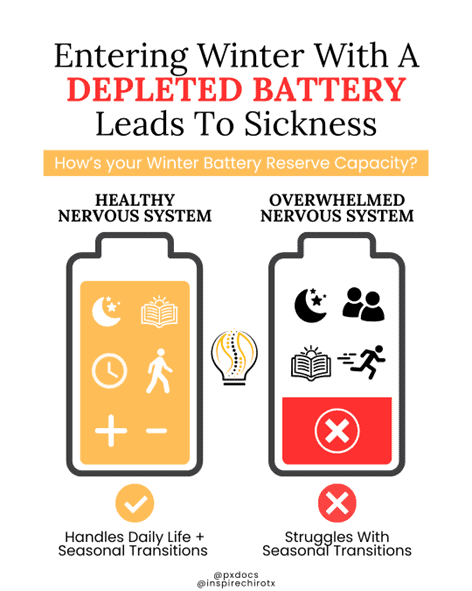
Now think of a phone battery:
- A healthy battery handles daily use plus extra demands
- A damaged battery drains quickly from basic tasks
Seasonal transitions add extra work to the nervous system.
If there’s no reserve left, symptoms appear.
This is why seasonal struggles are so common in children with Autism, ADHD, sensory processing challenges, anxiety, and immune issues.
Seasonal Transitions as Additional Neurological Work
Winter requires the nervous system to:
- Adjust sleep timing
- Maintain mood with less light
- Regulate body temperature
- Support immune defenses
For resilient systems, this happens automatically.
For overwhelmed systems, it becomes the breaking point.
That’s why so many families notice fall and winter backslides—it’s neurological exhaustion, not a coincidence.
How Early Life Stress Creates Seasonal Depression Vulnerability
Many seasonal struggles start long before winter ever arrives.
The “Perfect Storm” Framework
This pattern is called the Perfect Storm—a buildup of early stressors that disrupt nervous system development.
Common contributors include:
- Prenatal stress (maternal anxiety or chronic stress)
- Birth trauma (C-sections, forceps, vacuum delivery, long labor)
- Early childhood stressors (colic, reflux, frequent illness, antibiotics)
- Delayed motor development (skipped crawling, balance or coordination issues)
Each factor adds stress to a developing nervous system.
The Neurological Cascade
Over time, this can unfold in stages:
- Early sympathetic dominance (high-need babies, poor sleep, digestion issues)
- Sensory and emotional challenges in toddler years
- Multi-system struggles (sleep, immunity, digestion, regulation)
- Diagnostic labels by school age (ADHD, Autism, anxiety, SPD)
The key point:
Children don’t suddenly “develop” these challenges—they were present all along.
And a nervous system that struggled early will struggle even more during seasonal transitions.
Restoring Nervous System Resilience: A Different Path Forward
When seasonal depression is understood as a nervous system resilience issue, new options open up.
By supporting regulation at the root level, families can often reduce winter backslides and improve overall adaptability.
Understanding Subluxation and Neurological Dysfunction
In Neurologically-Focused Chiropractic Care, the focus is on subluxation—not bones being “out of place,” but interference in nervous system communication.
This interference often affects:
- The brainstem
- The upper cervical spine
- The vagus nerve pathway
When communication between the brain and body is disrupted, the nervous system struggles to shift out of stress mode. Adaptation—especially to seasonal change—becomes difficult.
INSiGHT Scanning: Objective Nervous System Assessment
INSiGHT Scanning Technology measures nervous system function, including Heart Rate Variability (HRV).
These scans:
- Identify stress and dysregulation patterns
- Track changes over time
- Help personalize care plans
They do not diagnose or treat conditions, but they help families understand how well the nervous system is functioning and adapting.
How It Helps
As nervous system interference is reduced:
- Regulation improves
- Reserve capacity increases
- Seasonal transitions become easier
Families often notice better sleep, energy, emotional regulation, and resilience—especially during winter.
Think of it as recharging the body’s battery, so winter doesn’t drain it as fast.
Supporting Nervous System Health Through Seasonal Changes
Alongside care, these family-friendly strategies help:
- Consistent sleep routines
- Morning sunlight exposure
- Whole-food, anti-inflammatory nutrition
- Gentle daily movement
- Deep breathing and stress regulation
- Strong social connection
- Limiting alcohol and excess caffeine
Progress—not perfection—is the goal.
From Surviving Winter to Thriving Year-Round
Seasonal depression isn’t just about daylight—it’s about nervous system resilience.
For many families, the challenges were there long before winter arrived. The good news?
The nervous system is designed to heal, adapt, and recover.
With the right support, many families are amazed at how much easier winter feels.
Request an appointment with us today to get started!
Not local to Inspire? Don’t worry! Visit the PX Docs Directory to find a qualified provider near you. https://pxdocs.com/px-docs/
Winter doesn’t have to be something your family just survives.
With the right foundation, it can be a season you move through with strength and confidence.
Original Article: https://pxdocs.com/mental-health/seasonal-depression/
PX Docs has established sourcing guidelines and relies on relevant, and credible sources for the data, facts, and expert insights and analysis we reference. You can learn more about our mission, ethics, and how we cite sources in our editorial policy.
SOURCES
- Effect of sunlight and season on serotonin turnover in the brain. Lambert, GW et al., The Lancet, Volume 360, Issue 9348, 1840 – 1842
- Naser Farhadi, Majid Gharghani, Zahra Farhadi, Effects of long-term light, darkness and oral administration of melatonin on serum levels of melatonin, Biomedical Journal, Volume 39, Issue 1, 2016, Pages 81-84, ISSN 2319-4170.
- Anglin RES, Samaan Z, Walter SD, McDonald SD. Vitamin D deficiency and depression in adults: systematic review and meta-analysis. British Journal of Psychiatry. 2013;202(2):100-107. doi:10.1192/bp.111.106666
- McDevitt RA, Neumaier JF. Regulation of dorsal raphe nucleus function by serotonin autoreceptors: a behavioral perspective. J Chem Neuroanat. 2011 Jul;41(4):234-46. doi: 10.1016/j.jchemneu.2011.05.001. Epub 2011 May 8. PMID: 21620956; PMCID: PMC3137942.
- Campbell PD, Miller AM, Woesner ME. Bright Light Therapy: Seasonal Affective Disorder and Beyond. Einstein J Biol Med. 2017;32:E13-E25. PMID: 31528147; PMCID: PMC6746555.
- Abou Elseoud A, Nissilä J, Liettu A, Remes J, Jokelainen J, Takala T, Aunio A, Starck T, Nikkinen J, Koponen H, Zang YF, Tervonen O, Timonen M, Kiviniemi V. Altered resting-state activity in seasonal affective disorder. Hum Brain Mapp. 2014 Jan;35(1):161-72. doi: 10.1002/hbm.22164. Epub 2012 Sep 15. PMID: 22987670; PMCID: PMC6869738.
- Marc Hébert, Craig W Beattie, Edwin M Tam, Lakshmi N Yatham, Raymond W Lam,
- Electroretinography in patients with winter seasonal affective disorder, Psychiatry Research, Volume 127, Issues 1–2, 2004, Pages 27-34, ISSN 0165-1781, https://doi.org/10.1016/j.psychres.2004.03.006.
- Coussons-Read ME. Effects of prenatal stress on pregnancy and human development: mechanisms and pathways. Obstet Med. 2013 Jun;6(2):52-57. doi: 10.1177/1753495X12473751. Epub 2013 May 3. PMID: 27757157; PMCID: PMC5052760.
- Davis EP, Sandman CA. The timing of prenatal exposure to maternal cortisol and psychosocial stress is associated with human infant cognitive development. Child Dev. 2010 Jan-Feb;81(1):131-48. doi: 10.1111/j.1467-8624.2009.01385.x. PMID: 20331658; PMCID: PMC2846100.
- Rahul Harikumar Lathakumari, Leela Kakithakara Vajravelu, Abhishek Satheesan, Sujith Ravi, Jayaprakash Thulukanam,
- Antibiotics and the gut microbiome: Understanding the impact on human health, Medicine in Microecology, Volume 20, 2024, 100106, ISSN 2590-0978, https://doi.org/10.1016/j.medmic.2024.100106.