
Updated on Sep 17, 2025
Author: Dr. Allie Wright
Revised for Inspire Chiropractic by Davis Madole, Reviewed by Dr. Shah Khan DC, CACCP
There is nothing quite like the moment a mom and dad discover they’re expecting. Those two little lines on a pregnancy test mark the beginning of an incredible journey — one that will eventually transform two tiny cells into a fully developed human baby.
Think about how much has to happen in roughly 40 weeks. Organs, limbs, the brain, nervous system, heart, lungs, muscles, and countless other systems all have to develop in an incredibly coordinated sequence.
That coordination is where the nervous system becomes so important.
In this article, we’ll explore fetal development through the lens of the nervous system, with a special focus on the Vagus Nerve, the Autonomic Nervous System (ANS), and Heart Rate Variability (HRV). We’ll also look at how a mother’s health and stress levels during pregnancy can influence her developing baby.
While genetics certainly matter, research increasingly shows that the environment a baby develops in — including maternal health and nervous system function — also plays an important role in development.
What is Fetal Development?
Fetal development is the process through which a fertilized egg develops into a fully formed baby. Throughout pregnancy, cells multiply, organs develop, and the brain and nervous system rapidly mature.
Most prenatal care focuses on measurements such as ultrasounds, lab work, growth patterns, and other physical markers. These are important tools, but there is another system worth paying close attention to: the nervous system.
The nervous system helps coordinate virtually every other system in the body. Understanding its development gives us another perspective on how a baby’s health is being established before birth.
The Role Of The Nervous System In Fetal Development and Prenatal Health
A healthy, well-regulated nervous system is important for both mom and baby during pregnancy.
Think of the mother’s nervous system as a conductor helping guide the environment in which the baby’s nervous system develops. Maternal stress, anxiety, and significant emotional challenges can influence fetal development through hormonal and physiological pathways.
The umbilical cord does more than transport oxygen and nutrients. It also connects the developing baby to the mother’s internal environment. When mom experiences prolonged stress, her sympathetic nervous system can remain activated, creating a physiological environment that may influence the developing baby.
This is why prenatal health needs to involve more than simply monitoring physical measurements. Supporting the mother’s nervous system is another important piece of the pregnancy picture.
Three areas are especially important:
- Optimal Autonomic Nervous System Development
- The Vagus Nerve
- Heart Rate Variability (HRV)
Autonomic Nervous System and Vagus Nerve Development
The nervous system begins developing extremely early in pregnancy, before many parents even know they’re expecting.
The basic progression looks something like this:
3 weeks:
- Autonomic Nervous System development begins
4 weeks:
- Major early brain structures begin developing
- Heart and diaphragm development begins
4-8 weeks:
- Cranial nerves and intestinal nervous system structures develop
6 weeks:
- Early parasympathetic structures begin developing
10-11 weeks:
- Sympathetic structures and the Enteric Nervous System continue developing
- Facial and spinal reflexes begin developing
- Brainstem activity becomes increasingly organized
13-20 weeks:
- The developing nervous system becomes increasingly responsive to maternal and environmental influences
- Cerebellar development and sensory systems continue maturing
26 weeks:
- Vagus Nerve myelination begins
32 weeks:
- Greater coordination develops between the brain’s hemispheres
37+ weeks:
- Autonomic Nervous System development reaches greater maturity as the baby prepares for birth
There is a lot of neurological development happening before a baby ever takes their first breath.
The takeaway is simple: the nervous system is developing early and helping organize many of the systems that develop afterward.
Nervous System Regulation
The Autonomic Nervous System helps regulate many essential functions throughout pregnancy and after birth, including:
- Heart rate and circulation
- Respiration
- Blood flow and nutrient delivery
- Temperature regulation
- Digestion
- Stress responses
- Reflexes and sensory development
- Movement
- Immune regulation
- Behavioral and emotional regulation
Because these systems are interconnected, disruptions in nervous system development may influence many areas of a child’s health and development.
This is why we believe prenatal care should look beyond basic measurements and also consider the health and regulation of the mother’s nervous system.
One tool that allows us to objectively measure nervous system regulation is Heart Rate Variability, or HRV.
HRV provides information about how adaptable and resilient the Autonomic Nervous System is, giving parents and providers another way to monitor nervous system function during pregnancy.
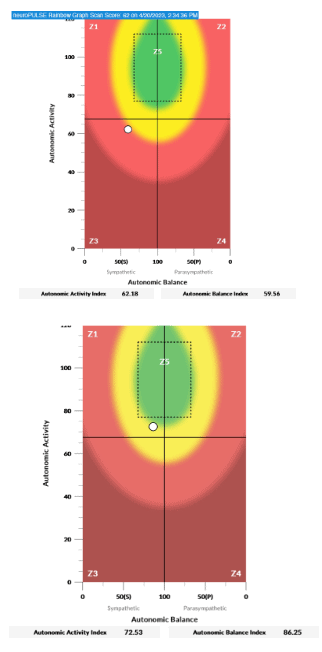
The Role Of Maternal Stress On Fetal Autonomic Nervous System Development
Mom’s health matters to baby’s development.
The baby’s nervous system begins developing before most mothers even know they’re pregnant, which is one reason why preconception health matters so much.
Occasional stress is normal. The challenge comes when stress becomes chronic and the nervous system has difficulty returning to a calm, regulated state.
Pregnancy can already bring significant physical and emotional demands, and modern life can add even more. Work, relationships, finances, lack of sleep, illness, and other stressors can all contribute to a mother’s overall stress load.
Supporting mom’s nervous system isn’t about eliminating every stressful moment. It’s about helping her body better adapt and recover from the stressors she inevitably encounters.
This is where HRV becomes particularly interesting.
The Role of Stress, Subluxation, and Dysautonomia in Child Development
In Neurologically-Focused Chiropractic Care, prolonged stress is one factor we consider when looking at nervous system dysregulation.
When the nervous system remains heavily biased toward the sympathetic “fight-or-flight” state, the parasympathetic system and Vagus Nerve may have a harder time doing their jobs.
This imbalance is commonly referred to as dysautonomia.
From our perspective, subluxation can also contribute to altered communication between the brain and body, potentially adding to this stress pattern.
The goal of care is not to diagnose or treat a medical condition, but to support healthier nervous system function and regulation.
Can You Measure This Stress? Introducing HRV To Fetal Development And Pregnancy Care
One of the most exciting tools we use to monitor nervous system function is HRV.
Heart Rate Variability measures the small changes in time between heartbeats. Rather than simply asking how fast the heart is beating, HRV gives us information about how flexibly the Autonomic Nervous System is responding.
Think of it like a battery and adaptability gauge for the nervous system.
A nervous system that can appropriately shift between activation and recovery is generally considered more adaptable than one that remains stuck in a chronically stressed state.
During pregnancy, mom’s nervous system is doing an enormous amount of work. Supporting her ability to regulate, recover, sleep, digest, and adapt is important for her well-being and may also help create a healthier environment for the developing baby.
The Impact Of HRV On Fetal Development
HRV is increasingly being studied in both maternal and fetal health.
Research has explored relationships between fetal HRV and factors such as:
- Fetal stress and distress
- Preterm birth
- Maternal stress
- Autonomic nervous system development
- Neurodevelopment
- Cardiovascular regulation
- Stress adaptability
It’s important to recognize that these relationships are still being studied and that HRV is not a diagnostic tool for predicting a child’s future health.
What HRV can provide is objective information about autonomic regulation and adaptability.
That makes it valuable as one piece of a broader picture of maternal and prenatal health.
How We Track HRV During Pregnancy For Fetal Development
At Inspire, measuring nervous system function is an important part of our approach to prenatal care.
HRV is one component of our INSiGHT Scans, which also assess other patterns related to nervous system function.
These measurements help us establish a baseline, identify areas of nervous system stress or dysregulation, and create a personalized care plan for the expecting mother.
The biggest advantage is that we can continue measuring over time.
Instead of simply asking, “Do you feel better?” we can also look at objective changes in nervous system function throughout pregnancy and into the postpartum period.
From there, our doctors can use Neuro-Tonal Adjustments designed to support healthier nervous system regulation.
How To Get The Help You Need
Pregnancy is one of the most exciting seasons of life, but it can also bring plenty of stress, uncertainty, and exhaustion.
You don’t have to eliminate every stressor. The goal is to help your body become more resilient and better equipped to adapt to the demands of pregnancy, birth, and life with a newborn.
Adding a Neurologically-Focused Prenatal Chiropractor to your care team can provide another layer of support, particularly when that care includes objective measurements such as HRV.
At Inspire Chiropractic, our goal is to help moms better understand their nervous system, track changes over time, and support healthier neurological function throughout pregnancy.
If you’re expecting, the best place to start is with an in-depth consultation and nervous system assessment to determine what support may be appropriate for you.
Remember: you don’t have to navigate pregnancy alone. Your health matters, too — and supporting mom is an important part of supporting baby.
Not local to Inspire? Don’t worry! Visit the PX Docs Directory to find a qualified provider near you. https://pxdocs.com/px-docs/
Original Article: https://pxdocs.com/vagus-nerve/vagus-nerves-role/
PX Docs has established sourcing guidelines and relies on relevant, and credible sources for the data, facts, and expert insights and analysis we reference. You can learn more about our mission, ethics, and how we cite sources in our editorial policy.
SOURCES
- DiPietro JA, Bornstein MH, Hahn CS, Costigan K, Achy-Brou A. Fetal heart rate and variability: stability and prediction to developmental outcomes in early childhood. Child Dev. 2007 Nov-Dec;78(6):1788-98. doi: 10.1111/j.1467-8624.2007.01099.x. PMID: 17988321; PMCID: PMC2267766.
- Semeia L, Bauer I, Sippel K, Hartkopf J, Schaal NK, Preissl H. Impact of maternal emotional state during pregnancy on fetal heart rate variability. Compr Psychoneuroendocrinol. 2023 Feb 28;14:100181. doi: 10.1016/j.cpnec.2023.100181. PMID: 36911250; PMCID: PMC9995932.
- Tiago Miguel Pinto, Cristina Nogueira-Silva & Bárbara Figueiredo (2023) Fetal heart rate variability and infant self-regulation: the impact of mother’s prenatal depressive symptoms, Journal of Reproductive and Infant Psychology, DOI: 10.1080/02646838.2023.2257730
- Cerritelli Francesco , Frasch Martin G. , Antonelli Marta C. , Viglione Chiara , Vecchi Stefano , Chiera Marco , Manzotti Andrea. A Review on the Vagus Nerve and Autonomic Nervous System During Fetal Development: Searching for Critical Windows. Frontiers in Neuroscience. VOLUME 15 2021.