
Updated on Apr 10, 2026
Author: Dr. Morgan Reimer
Revised for Inspire Chiropractic by Davis Madole, Reviewed by Dr. Shah Khan DC, CACCP
W sitting is a floor-sitting position where a child sits on their bottom with knees bent and legs rotated out behind them, forming a “W” shape.
Most children shift between several sitting positions during play, like criss-cross, side-sitting, or long-sitting. Concern arises when a child consistently defaults to W sitting and rarely uses other positions.
It’s most commonly seen between ages 3–6, but when it persists, it may signal underlying challenges with motor coordination, core stability, or nervous system regulation.
Why Children W Sit
Common explanations include:
- A wider, more stable base of support
- Reduced need for core engagement
- Structural factors like femoral anteversion
These factors describe what W sitting provides, but not why a child relies on it so heavily.
From a neurological perspective, W sitting often emerges as a compensation. When a child’s system struggles with balance, coordination, or postural control, they naturally choose the position that requires the least effort from the nervous system.
That’s why W sitting is often seen alongside other challenges like coordination difficulties, sensory issues, delayed milestones, or trouble sitting still.
These patterns are connected, not isolated.
Why Isn’t Core Strengthening Enough?
W sitting is often labeled as a “core strength issue,” but that’s only part of the picture.
Muscles don’t activate on their own — they respond to signals from the nervous system. If neurological communication is inefficient, core engagement will be limited no matter how much strengthening is done.
Postural control also depends on integrated sensory input from:
- Proprioception (body awareness)
- Vestibular system (balance)
- Vision
When these systems are not processing efficiently, compensatory movement patterns like W sitting can emerge.
How the “Perfect Storm” Contributes
At Inspire, we often see W sitting as part of a larger developmental picture we call the “Perfect Storm” — a buildup of stress across early development that impacts nervous system regulation.
Prenatal stress
Maternal stress during pregnancy can influence early nervous system development and shift autonomic balance toward a stress-dominant state.
Birth stress
Interventions such as forceps, vacuum extraction, C-sections, or induction can place strain on the upper neck and brainstem region, which plays a key role in posture and motor control.
Early childhood stress
Feeding challenges, sleep disruption, medications, and environmental stressors can further tax an already sensitive system.
Over time, the nervous system adapts by prioritizing efficiency and stability, often leading to compensatory patterns like W sitting.
How Neurologically-Focused Chiropractic Care Helps
This approach begins with understanding that W sitting is a signal, not the root problem.
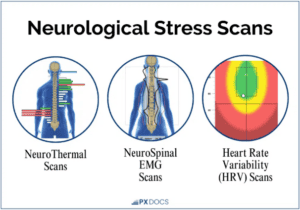
Advanced INSiGHT scans help assess nervous system function, including:
- NeuroThermal scans (autonomic balance)
- Surface EMG (muscle tension and coordination patterns)
- HRV (nervous system adaptability and regulation)
These scans do not diagnose conditions, but they help identify areas of neurological stress and dysregulation.
Gentle, specific adjustments are then used to reduce interference in the nervous system, supporting improved communication between brain and body.
As regulation improves, parents often notice broader changes such as:
- Better balance and coordination
- More varied sitting positions
- Improved confidence in movement
- More fluid motor patterns
What Parents Can Do at Home
Support doesn’t need to be complicated.
Encourage variety
Gently guide your child into different sitting positions during play, like criss-cross or side sitting. Keep it playful rather than corrective.
Promote movement
Activities like crawling games, climbing, obstacle courses, and bear crawls help build coordination and sensory integration.
Look at the bigger picture
W sitting often appears alongside other patterns like sensory challenges, delayed milestones, or emotional regulation struggles. These may share a common root.
What Should You Do If Your Child W Sits Often?
W sitting is not just a habit — for some children, it’s a visible sign of how their nervous system is organizing movement and stability.
While some children naturally outgrow it, persistent W sitting alongside other developmental concerns may indicate an underlying regulation issue that deserves a closer look.
If you’re concerned, a comprehensive neurological assessment can help clarify what’s driving the pattern and how best to support your child’s development.
Frequently Asked Questions
Is W sitting bad for my child?
Occasional W sitting is common. Persistent reliance on it may suggest challenges with core stability, coordination, or nervous system regulation.
Can W sitting affect hip development?
It may place the hips in a position of increased internal rotation. However, current evidence shows mixed findings on direct causation, and it is often linked to underlying movement patterns rather than being the sole cause.
Will my child grow out of it?
Some children do. Others continue the pattern if underlying coordination or neurological challenges are not addressed.
Is W sitting related to sensory issues?
Yes, it can be associated with sensory processing challenges, especially when proprioceptive or vestibular integration is less efficient.
How long does it take to see change?
Every child is different. Many parents report noticing shifts in movement patterns within weeks of consistent care, along with broader improvements in regulation and coordination.
Request an appointment with us today to get started!
Not local to Inspire? Don’t worry! Visit the PX Docs Directory to find a qualified provider near you. https://pxdocs.com/px-docs/
Original Article: https://pxdocs.com/developmental-delays/w-sitting/
PX Docs has established sourcing guidelines and relies on relevant, and credible sources for the data, facts, and expert insights and analysis we reference. You can learn more about our mission, ethics, and how we cite sources in our editorial policy.
SOURCES
- Nordon, D. G., Buff Passone, C. de G., da Silva, C. A. A., & Grangeiro, P. M. (2025). W-sitting in childhood: A systematic review. Acta Ortopédica Brasileira, 32(6), e279277. https://pmc.ncbi.nlm.nih.gov/articles/PMC11723520/
- Johns Hopkins Medicine. (n.d.). Femoral anteversion. https://www.hopkinsmedicine.org/health/conditions-and-diseases/femoral-anteversion
- Gash, M. C., Kandle, P. F., Murray, I. V., & Varacallo, M. A. (2023, April 1). Physiology, muscle contraction. In StatPearls [Internet]. StatPearls Publishing. https://www.ncbi.nlm.nih.gov/books/NBK537140/
- Gash, M. C., Kandle, P. F., Murray, I. V., & Varacallo, M. A. (2023). Physiology, Muscle Contraction. StatPearls [Internet]. https://www.ncbi.nlm.nih.gov/books/NBK537140/
- Zoccante, L., Ciceri, M. L., Chamitava, L., Di Gennaro, G., Cazzoletti, L., Zanolin, M. E., Darra, F., & Colizzi, M. (2021). Postural Control in Childhood: Investigating the Neurodevelopmental Gradient Hypothesis. 10;18(4):1693. PMC7916459. https://doi.org/10.1016/j.psc.2018.10.003
- Dahlerup, B. R., Egsmose, E. L., Siersma, V., Mortensen, E. L., Hedegaard, M., Knudsen, L. E., & Mathiesen, L. (2018). Maternal stress and placental function, a study using questionnaires and biomarkers at birth. 2018 Nov 15;13(11):e0207184. PMC6237336. https://pmc.ncbi.nlm.nih.gov/articles/PMC6237336/
- Nuttall, A. K., Bogat, G. A., Lonstein, J. S., Muzik, M., Grimm, K. J., & Granger, D. A. (2026). Timing of prenatal stress exposure predicts infant sympathetic nervous system and affective responses. Developmental Psychobiology, 68(2), Article e70140. https://pmc.ncbi.nlm.nih.gov/articles/PMC12968594/