
Updated on Jul 16, 2026
Author: Dr. Tony Ebel, DC, CPPFC, CCWP
Revised for Inspire Chiropractic by Davis Madole, Reviewed by Dr. Shah Khan DC, CACCP
Does your child struggle with paying attention, sitting still, controlling impulses, or managing emotions? If so, you are not alone.
Millions of children in the United States have been diagnosed with Attention Deficit Hyperactivity Disorder (ADHD), making it one of the most common childhood neurodevelopmental challenges today.
ADHD can impact much more than school performance. It can affect friendships, confidence, emotional regulation, family relationships, and everyday life.
But what if ADHD is more than simply a “behavior problem” or “deficit”?
By understanding the nervous system behind ADHD and providing the right support, we can help children better regulate, build confidence, and unlock their strengths.
What Is ADHD?
Attention Deficit Hyperactivity Disorder (ADHD) is a neurodevelopmental condition characterized by ongoing challenges with attention, impulse control, and activity levels.
While every child may experience moments of distraction, high energy, or impulsiveness, children with ADHD experience these challenges more frequently and intensely in ways that affect daily life.
Common signs of ADHD include:
Inattention
- Difficulty focusing or following instructions
- Easily distracted
- Forgetting tasks or losing items
- Trouble organizing responsibilities
Hyperactivity
- Constant movement or fidgeting
- Difficulty sitting still
- Excessive talking
- Feeling like they are always “on the go”
Impulsivity
- Interrupting others
- Acting before thinking
- Difficulty waiting their turn
- Struggling to consider consequences
ADHD can present differently in each child:
- Predominantly Inattentive Type: Difficulty with focus, organization, and completing tasks
- Predominantly Hyperactive-Impulsive Type: More challenges with movement and impulse control
- Combined Type: A combination of attention and hyperactivity challenges
ADHD affects children in different ways, but the struggles often extend beyond the classroom. Many children also experience challenges with emotional regulation, friendships, confidence, anxiety, sensory processing, and sleep.
ADHD also commonly overlaps with other challenges, including anxiety, Autism Spectrum Disorder, sensory processing issues, and learning difficulties.
If your child is struggling, remember: there is hope. Understanding the full picture of ADHD is the first step toward providing meaningful support.
What Causes ADHD and Other Mental Health Challenges?
For many years, ADHD has been explained through a simple “chemical imbalance” theory.
While brain chemistry and neurotransmitters like dopamine play an important role, research continues to show that ADHD is much more complex than a single imbalance.
ADHD develops through a combination of factors, including:
- Genetics
- Prenatal stress
- Birth experiences
- Environmental influences
- Early childhood stressors
- Lifestyle factors
The nervous system is shaped by everything a child experiences before and after birth.
This is why Inspire Chiropractic focuses on understanding the bigger picture behind ADHD rather than only looking at symptoms.
One framework we use to explain this is called the “Perfect Storm.”
Is ADHD a Mental Illness? Understanding “The Perfect Storm”
A child’s developing nervous system is constantly adapting.
However, when multiple stressors build upon each other, they can interfere with healthy regulation.
The “Perfect Storm” includes:
Maternal Stress
Stress during pregnancy can influence the developing nervous system and impact how a child responds to stress later in life.
Birth Stress
Birth interventions such as C-sections, forceps, vacuum extraction, or prolonged labor can place stress on a baby’s developing nervous system.
Early Childhood Stressors
Factors such as illness, antibiotic use, environmental stress, sensory overload, and other challenges can continue adding stress to a developing system.
Any one of these factors may not create a problem by itself.
But when multiple stressors accumulate, the nervous system may become stuck in a state of imbalance, affecting attention, behavior, emotional regulation, and overall function.
How Are ADHD Signs and Symptoms Recognized?
ADHD is typically evaluated through a comprehensive process that may include:
- Reviewing developmental history
- Gathering observations from parents and teachers
- Using symptom rating scales
- Evaluating school performance
- Screening for other conditions that may contribute to symptoms
A diagnosis can help identify challenges a child is experiencing.
However, many parents are searching for more than a label. They want to understand why their child is struggling and what may be happening beneath the surface.
Limitations of a Symptom-Based Approach
Traditional ADHD evaluations focus primarily on behaviors and symptoms.
While this information is valuable, symptoms alone do not always reveal what is happening neurologically.
At Inspire, we believe understanding nervous system function is an important part of supporting children with ADHD-related challenges.
A neurological assessment can provide additional insight into:
- Nervous system regulation
- Brain-body communication
- Sensory processing
- Stress patterns
- Neurological balance
By looking deeper, families can better understand the unique factors contributing to their child’s struggles.
Conventional ADHD Treatment Options
Medication and behavioral therapies can be helpful tools for some children.
However, many families also want to understand the underlying factors contributing to their child’s challenges.
Stimulant medications may come with potential side effects, including:
- Appetite changes
- Sleep difficulties
- Mood changes
- Headaches
- Digestive issues
- Increased heart rate
While these options may provide symptom support, they do not always address the nervous system patterns behind ADHD.
This is why many families seek a more comprehensive approach.
Neurological Dysfunction as the Root Cause
The nervous system plays a major role in attention, behavior, emotional regulation, and stress response.
At the center of this is the Autonomic Nervous System (ANS), which controls automatic functions like:
- Heart rate
- Digestion
- Immune function
- Stress response
The ANS has two main branches:
Sympathetic Nervous System
The “gas pedal” responsible for alertness, action, and fight-or-flight responses.
Parasympathetic Nervous System
The “brake pedal” responsible for calm, recovery, digestion, and regulation.
A healthy nervous system moves between these two states easily.
However, when a child experiences ongoing stress, the nervous system can become stuck in a heightened state of alert.
This can make it harder to focus, regulate emotions, sleep, process sensory information, and adapt to everyday challenges.
INSiGHT Scans and Neurologically-Focused Chiropractic
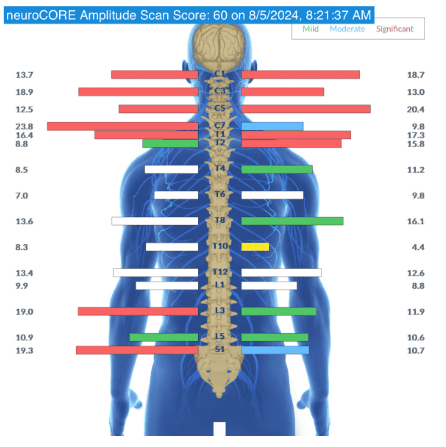
At Inspire Chiropractic, we use INSiGHT Scans to better understand nervous system function and create individualized care plans.
These non-invasive scans measure:
NeuroThermal Scan
Measures temperature patterns along the spine related to nervous system regulation.
Neuro-EMG
Measures muscle tension patterns that may reflect nervous system stress.
Heart Rate Variability (HRV)
Measures nervous system adaptability and balance between stress and recovery.
Together with a detailed consultation and neurological examination, these scans help provide a clearer picture of what may be affecting your child’s nervous system.
INSiGHT Scans are not a diagnosis or treatment for ADHD. They are an assessment tool designed to provide objective information about nervous system function.
Unlocking Your ADHD Child’s Full Potential
If you are raising a child with ADHD, you already know there is so much more to them than their challenges.
These children are often creative, energetic, passionate, curious, and incredibly gifted.
The goal is not to change who they are.
The goal is to help their nervous system function in a way that allows their strengths to shine.
A dysregulated nervous system can make ADHD symptoms feel overwhelming. But when regulation improves, many families report seeing positive changes in areas like:
- Emotional control
- Sleep
- Focus
- Confidence
- Adaptability
At Inspire, we believe every child deserves the opportunity to thrive.
Whether your child has recently received a diagnosis, has been struggling for years, or you are simply looking for answers, understanding nervous system function may provide an important piece of the puzzle.
The first step is a comprehensive consultation and INSiGHT Scan evaluation to better understand your child’s unique nervous system.
With the right support, children with ADHD can move beyond their challenges and discover the strengths that make them unique.
Frequently Asked Questions
What causes ADHD in children?
ADHD is influenced by multiple factors, including genetics, brain development, environment, prenatal experiences, and early childhood stressors. It is not caused by one single factor.
Is ADHD just a behavior problem?
No. ADHD involves differences in attention, impulse control, and nervous system regulation. Behavior is often a reflection of what is happening neurologically beneath the surface.
Can ADHD be improved naturally?
Many families explore lifestyle changes, nutrition, therapy, and nervous system-focused approaches alongside traditional care options. Every child is different, so families should discuss the best approach with qualified providers.
Can chiropractic care help children with ADHD?
Neurologically-Focused Chiropractic Care focuses on supporting nervous system regulation and brain-body communication. Many families seek this approach as part of a broader plan to support their child’s health and development.
Are INSiGHT Scans used to diagnose ADHD?
No. INSiGHT Scans do not diagnose ADHD or any medical condition. They measure aspects of nervous system function and help providers better understand a child’s neurological patterns.
What should I do if I think my child has ADHD?
Start by seeking a comprehensive evaluation and learning more about your child’s unique needs. Understanding the nervous system behind their challenges can help guide the right support plan.
Request an appointment with us today to get started!
Not local to Inspire? Don’t worry! Visit the PX Docs Directory to find a qualified provider near you. https://pxdocs.com/px-docs/
Original Article: https://pxdocs.com/adhd/what-is-adhd/
PX Docs has established sourcing guidelines and relies on relevant, and credible sources for the data, facts, and expert insights and analysis we reference. You can learn more about our mission, ethics, and how we cite sources in our editorial policy.
SOURCES
- CDC on ADHD Data:
Centers for Disease Control and Prevention. (2023, April 4). Data and statistics about ADHD. CDC. https://www.cdc.gov/adhd/data/index.html - More to ADHD on Coexisting Disorders:
Takeda Pharmaceuticals. (n.d.). ADHD and coexisting disorders in pediatric patients. More to ADHD. https://www.moretoadhd.com/pediatric/adhd-coexisting-disorders - NCBI PMC on ADHD:
Faraone, S. V., Banaschewski, T., Coghill, D., Zheng, Y., Biederman, J., & Bellgrove, M. A. (2022). The world federation of ADHD international consensus statement: 208 evidence-based conclusions about the disorder. Neuroscience & Biobehavioral Reviews, 139, 104-121. https://doi.org/10.1016/j.neubiorev.2022.104757 - Frontiers in Psychiatry on ADHD and Resilience:
Richardson, A. J. (2022). Enhancing resilience in children with ADHD through behavioral interventions: A focused review. Frontiers in Psychiatry, 13, Article 927411. https://doi.org/10.3389/fpsyt.2022.927411 - American Heart Association on Prenatal Stress:
American Heart Association News. (2021, May 6). Prenatal stress can program a child’s brain for later health issues. American Heart Association. https://www.heart.org/en/news/2021/05/06/prenatal-stress-can-program-a-childs-brain-for-later-health-issues - ScienceDirect on ADHD and Digital Media Use:
Mullen, K. (2024). Exploring the link between digital media consumption and ADHD symptoms. Journal of Digital Health, 4(1), Article 100009. https://doi.org/10.1016/j.jdh.2024.100009 - NCBI PMC on ADHD and Sleep Problems:
Becker, S. P., & Sidol, C. A. (2018). Predicting academic achievement with ADHD symptoms: The mediating role of sleep problems. Journal of Clinical Child & Adolescent Psychology, 47(6), 779-792. https://doi.org/10.1080/15374416.2017.1342547 - NCBI Book Table on ADHD Prevalence:
National Academies of Sciences, Engineering, and Medicine. (2018). ADHD prevalence by age group. In The prevalence and treatment of mental health disorders in children. National Academies Press. https://www.ncbi.nlm.nih.gov/books/NBK519712/table/ch3.t3/ - NCBI PMC on Parental Impact on ADHD Treatment:
James, T. L., & Burgess, D. (2023). The role of parental involvement in successful ADHD treatment outcomes. Pediatric Neuropsychology, 19(4), 455-469. https://doi.org/10.1097/PNR.0000000000001045 - NCBI PMC on ADHD Treatment:
Thomas, R., & Sanders, S. (2023). Advances in ADHD treatment: A systematic review. Journal of Child Psychology and Psychiatry, 64(3), 360-372. https://doi.org/10.1111/jcpp.13567 - Frontiers in Psychiatry on ADHD and Executive Functioning:
Brown, T. E. (2020). Executive functioning impairments in ADHD: Implications for practice. Frontiers in Psychiatry, 11, Article 244. https://doi.org/10.3389/fpsyt.2020.00244