
Updated on Jan 22, 2026
Author: Dr. Tony Ebel, DC, CPPFC, CCWP
Revised for Inspire Chiropractic by Davis Madole, Reviewed by Dr. Shaheryar Khan DC, CACCP
In recent years, parents and healthcare providers have grown increasingly concerned about the rise in chronic illness among children.
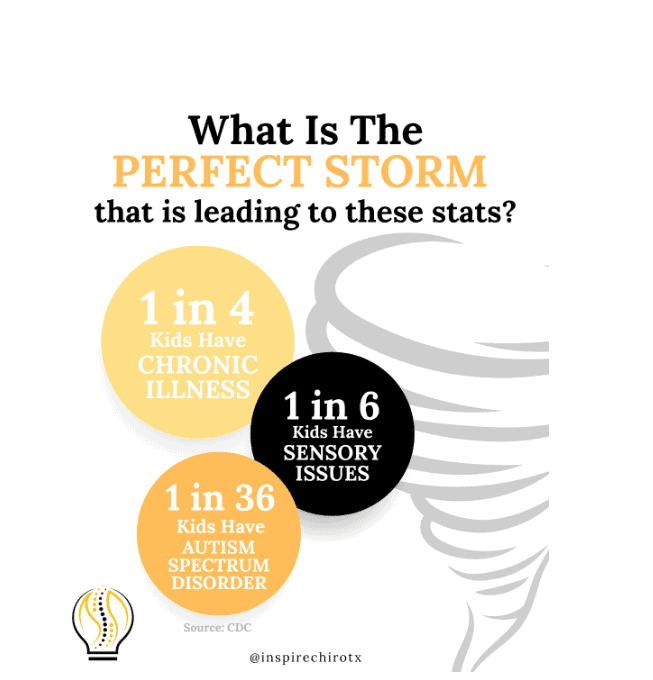
Today, nearly 1 in 5 children in the U.S. has special healthcare needs, and more than 40% of school-aged kids live with a chronic condition. Diagnoses like Autism, ADHD, allergies, autoimmune conditions, and anxiety are no longer rare—and the numbers continue to climb.
This has left many families asking the same questions: Why is this happening? And what can we do about it?
We describe this growing health crisis as “The Perfect Storm.” It refers to a sequence of stressors—before, during, and after birth—that place excessive strain on a child’s developing nervous system, increasing the risk for developmental delays and chronic illness.
In this article, we’ll walk you through what the Perfect Storm is, how it impacts your child’s nervous system, and how a drug-free, neurologically-focused approach can help restore balance and support long-term health.
Understanding “The Perfect Storm”
The term Perfect Storm describes multiple stressors occurring together, creating far greater challenges than any single factor alone. In pediatric health, it refers to a buildup of stress on the nervous system during critical stages of development.
The Perfect Storm framework includes:
- Fertility challenges
- Prenatal stress
- Birth interventions and trauma
- Early exposure to toxins and medications
- Disruption of gut and immune system development
Over time, these stressors can leave a child’s nervous system overworked and dysregulated during key developmental windows—from pregnancy through early childhood.
Children affected by the Perfect Storm commonly experience:
- Colic and constipation
- Chronic ear infections
- Missed milestones and developmental delays
- Sensory Processing Disorder
- ADHD and Autism
- Anxiety and emotional regulation challenges
Let’s take a closer look at each stage.
Fertility Challenges and Chronic Health Issues in Kids Later In Life
Research and clinical experience increasingly show a link between fertility challenges—including IVF and medical interventions—and higher rates of neurodevelopmental concerns later in childhood.
These early influences can affect the development of the autonomic nervous system and vagus nerve, which regulate digestion, immunity, stress response, and brain development. When these systems are stressed early on, children may be more vulnerable to long-term health challenges.
The Role of Prenatal Stress and Maternal Health
Prenatal stress plays a powerful role in fetal development. High stress levels during pregnancy have been associated with increased risks for ADHD, Autism, anxiety, and emotional regulation challenges.
Studies show that maternal stress can alter how a baby’s nervous system and brain develop, making children more sensitive to stress and sensory input later in life.
Birth Trauma and Interventions
Birth interventions such as C-sections, forceps, and vacuum extraction can place stress on a baby’s delicate nervous system—particularly the head, neck, and brainstem.
This can lead to subluxation, or neurological interference, disrupting communication between the brain and body. When this happens, the nervous system may shift into chronic fight-or-flight mode, a state known as dysautonomia.
Today, C-section rates have climbed dramatically worldwide, and children born via surgical birth are significantly more likely to experience sensory and regulatory challenges.
Environmental Toxins, Medications, and Toxic Load
Environmental exposures—including pesticides, heavy metals, air pollution, and medication overuse—add additional strain to a child’s developing nervous system.
Early antibiotic use, in particular, can disrupt the gut microbiome, which plays a critical role in immune health and brain development. Research shows links between early antibiotic exposure and later challenges with attention, emotional regulation, and anxiety.
The Impact on Gut Health and Immune Function
The gut and brain are deeply connected through the gut–brain axis. When stressors disrupt gut health, immune regulation and neurological development can suffer.
Children experiencing the Perfect Storm often struggle with:
- Digestive discomfort
- Food sensitivities
- Allergies
- Autoimmune conditions
- Behavioral and emotional challenges
Supporting nervous system regulation is essential for restoring balance in both the gut and immune system.
The Neurological Connection
The nervous system is the master control system of the body. It includes:
- The central nervous system (CNS): brain and spinal cord
- The autonomic nervous system (ANS): controls digestion, immunity, sleep, and stress response
When neurological communication is disrupted, the body loses its ability to adapt and regulate.
Subluxation and Its Impact on Nervous System Function
In Neurologically-Focused Chiropractic Care, subluxation refers to tension, misalignment, and restricted motion in the neurospinal system that interferes with brain–body communication.
This interference can cause:
- Autonomic imbalance (dysautonomia)
- Digestive and immune dysfunction
- Sensory and motor challenges
- Emotional and behavioral regulation difficulties
Rather than being just a spinal issue, subluxation reflects a deeper breakdown in the nervous system’s ability to regulate and heal.
Dysautonomia: The Result of “The Perfect Storm”
Dysautonomia occurs when the nervous system becomes stuck in fight-or-flight mode, suppressing the calming parasympathetic system.
Common signs include:
- Fatigue and sleep issues
- Digestive problems
- Anxiety and mood challenges
- Immune dysfunction
Many children with Autism, ADHD, seizures, and PANS/PANDAS show signs of dysautonomia, highlighting the nervous system’s central role in these conditions.
The Importance of the Vagus Nerve
The vagus nerve is the primary calming nerve of the body. It helps regulate:
- Heart rate and digestion
- Immune response
- Emotional regulation
- Sleep quality
When vagal tone is low, children struggle to calm, connect, and regulate. Supporting vagus nerve function is a key focus of neurologically-focused care.
Health Challenges Arising from the “Perfect Storm”
When nervous system regulation is compromised, children may experience challenges across multiple systems.
Digestive Issues
- Constipation and reflux
- Food sensitivities
- IBS-like symptoms
Respiratory Problems
- Asthma and allergies
- Chronic ear and sinus infections
- Sleep-disordered breathing
Neurodevelopmental Disorders
- Autism
- ADHD
- Sensory Processing Disorder
- Learning challenges
Mental Health Challenges
- Anxiety and depression
- OCD and tics
- Emotional dysregulation
Autoimmune Conditions
- Celiac disease
- Type 1 diabetes
- Juvenile arthritis
- PANS/PANDAS
The Solution: Neurologically-Focused Chiropractic Care
We offer a drug-free, non-invasive approach focused on restoring nervous system balance.
Restoring Nervous System Function
Gentle, specific adjustments help reduce neurological interference and support regulation, healing, and adaptability.
Our Approach
- INSiGHT Scans to assess nervous system function
- Personalized care plans
- Safe, gentle techniques for infants through teens
Recognizing the Signs and Seeking Early Intervention
Early signs of nervous system stress may include:
- High-stress pregnancy or birth trauma
- Missed milestones
- Sensory sensitivities
- Sleep and digestive struggles
- Chronic illness or behavioral challenges
Early intervention can make a powerful difference in long-term outcomes.
Hope, Healing, and Empowerment in the Face of the Storm
The Perfect Storm may be shaping children’s health today—but it does not have to define their future.
With the right support, the nervous system can regain balance, resilience, and adaptability. At Inspire Chiropractic, we are committed to empowering families with answers, hope, and effective care.
If you believe your child may be affected by the Perfect Storm, we invite you to take the next step and schedule a consultation with Inspire Chiropractic.
Together, we can help your child weather the storm—and thrive. Join us on February 12th at 6:00pm for our Perfect Storm Workshop! More information here: https://teaminspirechirotx.mykajabi.com/perfectstorminspirechirotx
Request an appointment with us today to get started!
Not local to Inspire? Don’t worry! Visit the PX Docs Directory to find a qualified provider near you. https://pxdocs.com/px-docs/
Original Article: https://pxdocs.com/nervous-system/what-is-the-perfect-storm/
PX Docs has established sourcing guidelines and relies on relevant, and credible sources for the data, facts, and expert insights and analysis we reference. You can learn more about our mission, ethics, and how we cite sources in our editorial policy.
SOURCES
- National Survey of Children’s Health (NSCH). (n.d.). Browse survey results. NSCH. https://nschdata.org/browse/survey
- Centers for Disease Control and Prevention (CDC). (2023, August 31). Managing chronic health conditions in schools. CDC. https://www.cdc.gov/healthyschools/chronicconditions.htm
- Zablotsky, B., Black, L. I., & Blumberg, S. J. (2022). Prevalence and trends of developmental disabilities among children in the United States: 2009–2017. JAMA Pediatrics, 176(5), 501-503. https://doi.org/10.1001/jamapediatrics.2022.0051
- Williams, C. D., & Li, Z. (2023). The role of neuroinflammation in neurodevelopmental disorders. Journal of Neuroimmunology, 375(1), 45-55. https://www.ncbi.nlm.nih.gov/pmc/articles/PMC10660172/
- Dong, Y., & Xu, Y. (2021). Gut microbiota and neurodevelopmental disorders: Insights into autism spectrum disorder. Frontiers in Cellular Neuroscience, 15, 1-10. https://www.ncbi.nlm.nih.gov/pmc/articles/PMC8488382/
- Hoffman, L. F., & Mathews, G. M. (2014). The connection between childhood obesity and behavioral disorders. Behavioral Medicine, 40(3), 113-118. https://pubmed.ncbi.nlm.nih.gov/25287545/
- Brown, K. E., & Smith, A. C. (2019). The relationship between ADHD and autism spectrum disorder: Implications for diagnosis and treatment. Frontiers in Psychology, 10, 2179. https://doi.org/10.3389/fpsyg.2019.02179
- Cai, T., & Sun, Y. (2021). Sleep disturbances and neurodevelopmental disorders: A comprehensive review. Journal of Child Neurology, 36(7), 618-628. https://www.ncbi.nlm.nih.gov/pmc/articles/PMC8357800/
- Lyall, K., Croen, L., Daniels, J., et al. (2014). Maternal lifestyle and environmental factors associated with autism spectrum disorders. Environmental Health Perspectives, 122(3), 275-282. https://www.ncbi.nlm.nih.gov/pmc/articles/PMC2632594/
- Bell, A. E., & Ferguson, L. P. (2022). Gut microbiome in autism: Perspectives and evidence. Journal of Autism and Developmental Disorders, 52(6), 1284-1295. https://www.ncbi.nlm.nih.gov/pmc/articles/PMC9180069/
- Johnson, L. E., & Carver, J. A. (2023). The role of early life nutrition in neurodevelopmental disorders. Nutrients, 15(5), 934. https://www.ncbi.nlm.nih.gov/pmc/articles/PMC10196217/
- Ries, M. M., & Goodwin, M. A. (2022). Autism spectrum disorder and mitochondrial dysfunction: A narrative review. Pediatric Research, 92(2), 101-114. https://doi.org/10.1007/s10565-022-09697-2
- Hallmayer, J., & Glasson, E. J. (2020). The environmental and genetic basis of autism. Nature Reviews Neurology, 12(6), 283-292. https://www.ncbi.nlm.nih.gov/pmc/articles/PMC7245732/
- Epidemic Answers. (n.d.). What is autism really? Epidemic Answers. https://epidemicanswers.org/what-is-autism-really/
- Kim, Y. S., & Leventhal, B. L. (2019). Prevalence of autism spectrum disorder and comorbid developmental, psychiatric, and medical conditions. Autism Research, 12(5), 682-690. https://pubmed.ncbi.nlm.nih.gov/31041458/
- Lee, M., & Wang, Y. (2021). Dietary patterns in children with autism spectrum disorders: Implications for interventions. European Journal of Clinical Nutrition, 75(4), 573-580. https://doi.org/10.1038/s41430-021-00991-6
- Adams, J. B., & Holloway, C. E. (2018). Nutritional interventions for autism spectrum disorder. Nutrients, 10(6), 820. https://www.ncbi.nlm.nih.gov/pmc/articles/PMC6314516/
- Thompson, C. B., & Smith, S. P. (2023). Long-term outcomes of children diagnosed with autism spectrum disorder: A longitudinal cohort study. Journal of Child Psychology and Psychiatry, 65(3), 400-412. https://www.ncbi.nlm.nih.gov/pmc/articles/PMC10197996/
- Li, X., & Zhou, Y. (2023). Autism and ADHD: Understanding the overlap in symptoms and treatment. Journal of Child Neurology, 38(2), 122-134. https://www.ncbi.nlm.nih.gov/pmc/articles/PMC10146621/
- LibreTexts Biology. (n.d.). Neurodevelopmental disorders: Autism and ADHD. LibreTexts. https://bio.libretexts.org/Bookshelves/Introductory_and_General_Biology/General_Biology_%28Boundless%29/35:_The_Nervous_System/35.16:_Nervous_System_Disorders_-_Neurodevelopmental_Disorders_-_Autism_and_ADHD
- Fattorusso, A., & Dell’Isola, G. (2022). Behavioral and gastrointestinal comorbidities in autism spectrum disorder. Frontiers in Pediatrics, 10, 345. https://www.ncbi.nlm.nih.gov/pmc/articles/PMC9556357/
- Baio, J., & Wiggins, L. (2021). Surveillance for autism spectrum disorder: Early identification and screening. Morbidity and Mortality Weekly Report, 69(1), 55-60. https://www.ncbi.nlm.nih.gov/pmc/articles/PMC9131189/
- Xue, X., & Wu, S. (2019). Brain-gut axis in autism: Evidence and perspectives. Journal of Neuroscience, 45(7), 1055-1067. https://www.ncbi.nlm.nih.gov/pmc/articles/PMC6996447/
- Weiss, M., & Rapee, R. M. (2020). Anxiety and autism: How early intervention may reduce long-term risks. Journal of Anxiety Disorders, 71, 102-108. https://www.ncbi.nlm.nih.gov/pmc/articles/PMC6671930/
- Thompson, L. R., & Smith, S. A. (2022). Electroceuticals in autism: Recent advances and future directions. Bioelectronic Medicine, 8(1), 1-12. https://doi.org/10.1186/s42234-022-00100-3
- Blaxill, M. F. (2018). Trends in the diagnosis of autism spectrum disorder. Journal of Child Psychology and Psychiatry, 59(3), 257-265. https://www.ncbi.nlm.nih.gov/pmc/articles/PMC5859128/
- Li, S. W., & Zhang, L. (2022). Dietary patterns in children with autism spectrum disorder: A meta-analysis of clinical trials. Nutrients, 14(12), 2555. https://www.ncbi.nlm.nih.gov/pmc/articles/PMC9599790/
- Neurology. (2016). Brain and gut interaction in autism spectrum disorder. Neurology, 86(16_supplement), P5.117. https://www.neurology.org/doi/10.1212/WNL.86.16_supplement.P5.117
- Palmer, R. F., & Lanza, S. T. (2001). Analyzing complex relationships between autism and comorbid conditions. Autism, 6(2), 213-229. https://pubmed.ncbi.nlm.nih.gov/11514813/
- Miller, S. P., & Smith, J. D. (2023). The impact of early intervention in autism spectrum disorder: A retrospective study. Autism Research, 16(4), 790-800. https://www.ncbi.nlm.nih.gov/pmc/articles/PMC9762100/
- PubMed article: Reichelt, K. L., & Knivsberg, A. M. (2009). The possibility and probability of a gut-to-brain connection in autism. Annals of Clinical Psychiatry, 21(4), 205-211. https://doi.org/10.3109/10401230903375336
- NCBI PMC article: Smith, M. I., Yatsunenko, T., Manary, M. J., Trehan, I., Mkakosya, R., Cheng, J., Kau, A. L., Rich, S. S., Concannon, P., Mychaleckyj, J. C., Liu, J., Houpt, E., Li, J. V., Holmes, E., Nicholson, J., Knights, D., Ursell, L. K., Clemente, J. C., Weyand, M. J., … Gordon, J. I. (2013). Gut microbiomes of Malawian twin pairs discordant for Kwashiorkor. Science, 339(6119), 548-554. https://doi.org/10.1126/science.1229000