
Updated on Dec 18, 2025
Author: Dr. Tony Ebel, DC, CPPFC, CCWP
Revised for Inspire Chiropractic by Davis Madole, Reviewed by Dr. Shaheryar Khan DC, CACCP
With the growing use of birth interventions and increased rates of birth trauma, we are seeing more cases of torticollis (wryneck) in clinics every year.
Unfortunately, traditional medicine has largely failed to update its understanding of why torticollis develops and how to fully resolve it. As a result, many families—like Nathan’s—are offered limited options such as physical or occupational therapy that often address symptoms, but not the root cause.
Nathan struggled with stiffness, discomfort, delayed milestones, and frequent ear infections. His mom tried everything she was told, but therapy alone wasn’t helping. Desperate for answers, she began researching other options and discovered Pediatric Chiropractic Care.
More parents today are doing the same—and seeing meaningful, lasting results with a gentler, neurologically-focused approach.
What Is Torticollis?
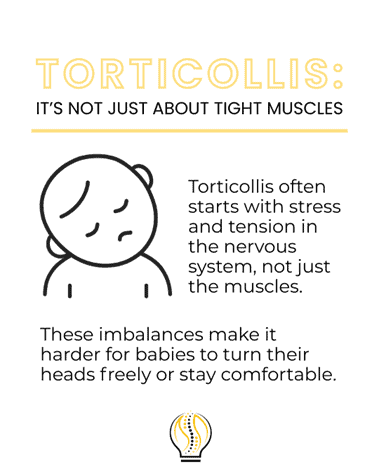
Torticollis in infants presents as a stiff, twisted neck, where the baby’s head consistently tilts to one side and has difficulty rotating freely.
While severe cases are easy to identify, many mild to moderate cases are missed or dismissed, with parents often told to “wait and see” or that their baby will “grow out of it.”
In our experience, untreated torticollis rarely resolves fully on its own.
Signs and Symptoms of Torticollis in Infants
Infants don’t express pain the way older children do. Instead, torticollis may show up as:
- Excessive crying, irritability, or colic
- Difficulty nursing or latching
- Reflux or digestive issues
- Head consistently tilted to one side
- Limited neck movement
- Always resting in the same position
- Poor sleep
- Tight or swollen neck muscles
- A small lump in the neck muscle
- Facial asymmetry
- Increased risk of plagiocephaly and motor delays
What Causes Torticollis?
Medically, torticollis may be labeled congenital due to positioning in the womb, breech presentation, or rare genetic conditions.
However, the most common form is acquired torticollis, and the most frequent cause is birth trauma.
Forceps, vacuum extraction, and even C-section deliveries place significant strain on an infant’s head and neck. This stress can lead to subluxation, which contributes to the tightness, fixation, and neurological imbalance seen in torticollis.
Subluxation Includes:
- Misalignment of spinal joints
- Fixation and reduced motion
- Neurological imbalance from altered sensory input
The more severe the torticollis, the more significant these subluxation patterns tend to be.
Care Options for Torticollis
Pediatricians may identify torticollis, but they often refer directly to physical therapy. While PT can help with movement, many parents report that stretching alone is painful, stressful, and sometimes worsens symptoms by keeping the nervous system stuck in fight-or-flight (dysautonomia).
The Pediatric Chiropractic Approach
Pediatric Chiropractic Care addresses the neurological cause, not just the muscle tightness:
- Identify the exact location and severity of subluxation
- Apply gentle, specific neuro-tonal adjustments
- Monitor closely during growth spurts, illness, and stress
When chiropractic care is used first, parents often find that PT exercises become easier, gentler, and more effective. Providers frequently work alongside therapy teams for the best outcomes.
Why Full Resolution Matters
Many older children we evaluate had torticollis as infants, completed traditional care, but still show retained patterns years later—confirmed through exam findings and INSiGHT Scans.
If subluxation and dysautonomia aren’t fully resolved, they can contribute to:
- Gross and fine motor delays
- Sensory challenges
- ADHD
- Ongoing ear infections
Tight neck muscles can also interfere with Eustachian tube drainage, increasing the risk of ear and respiratory infections such as croup, chronic cough, and RSV.
Book Your Appointment Today
Many parents notice improvements within just a few visits, though full resolution often takes weeks to a few months. We will review your child’s personalized care plan during a Report of Findings visit.
There is no cookie-cutter care here. Every child receives individualized assessment, scanning, and gentle care focused on true root causes.
In Nathan’s case:
- Month 1: digestive issues and eczema resolved
- Month 2: mobility improved, milestones returned, ear infections stopped
Request an appointment with us today to get started!
Not local to Inspire? Don’t worry! Visit the PX Docs Directory to find a qualified provider near you. https://pxdocs.com/px-docs/
Early care matters—and the right care can make all the difference.
Original Article: https://pxdocs.com/birth-trauma/what-is-torticollis/
PX Docs has established sourcing guidelines and relies on relevant, and credible sources for the data, facts, and expert insights and analysis we reference. You can learn more about our mission, ethics, and how we cite sources in our editorial policy.