
Updated on Mar 20, 2026
Author: Dr. Allie Wright
Revised for Inspire Chiropractic by Davis Madole, Reviewed by Dr. Shah Khan DC, CACCP
Roughly 35% of children in the U.S. aren’t getting enough sleep. If you’re reading this at 2 AM with an exhausted child who still won’t settle, you already know how real that struggle is.
You’ve likely tried everything — earlier bedtimes, blackout curtains, melatonin. Your child is clearly tired, but their body won’t let them rest.
Sleep struggles aren’t just behavioral. Deep, restorative sleep depends on a nervous system that can actually shift into “rest mode.” When that system is stuck, no amount of sleep routines will fix it.
What Sleep Actually Does for a Child’s Body
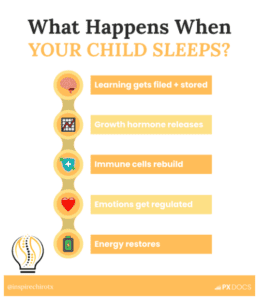
Sleep is when your child’s body and brain do their most important work.
- The brain organizes learning and memory
- Growth hormone is released for development
- The immune system strengthens
- Emotions are processed and regulated
This is why poor sleep shows up as struggles in school, frequent illness, or emotional outbursts. It’s not just “being tired” — it’s a system that hasn’t had the chance to restore.
But all of this depends on one thing: a nervous system that can shift into deep, restorative states.
Why So Many Kids Can’t Get Restorative Sleep
If your child fights sleep despite being exhausted, you’re not dealing with a routine issue — you’re dealing with a regulation issue.
The Exhausted-But-Wired Pattern
Many parents describe their child as “tired but wired.”
They:
- Take 1–3 hours to fall asleep
- Wake frequently
- Wake early and unrested
This happens when the sympathetic nervous system (gas pedal) is stuck on, and the parasympathetic system (brake pedal) can’t take over.
These aren’t separate problems — they’re all signs of the same root issue: a nervous system that can’t regulate the sleep-wake cycle.
The Nervous System’s Role in Sleep
Sleep is controlled by the autonomic nervous system.
The key player is the vagus nerve, which helps the body:
- Slow heart rate
- Relax muscles
- Shift into rest and repair
If this system isn’t functioning properly, the body can’t fully enter deep sleep. Kids may stay in light, restless sleep or struggle to fall asleep at all.
Often, sleep problems are the first sign of nervous system dysregulation — before digestion, immune, or behavioral challenges appear.
How the “Perfect Storm” Disrupts Sleep
Sleep issues rarely appear out of nowhere. They’re often part of a bigger pattern we call The Perfect Storm:
- Prenatal stress → heightened stress response from the start
- Birth stress or trauma → interference in the upper neck and nervous system
- Early childhood stressors → illness, antibiotics, gut issues
Each layer adds stress to an already overwhelmed system, making sleep harder and harder to regulate.
The Hidden Cost of Poor Sleep
When kids don’t sleep well, it affects everything:
- Hyperactivity and poor focus (often mistaken for ADHD)
- Frequent illness due to weakened immunity
- Emotional dysregulation and meltdowns
- Difficulty learning and retaining information
It becomes a cycle:
Poor sleep → weaker immune system → more illness → more stress → worse sleep.
Restoring Sleep at the Source
We don’t treat sleep as a standalone issue.
We focus on the nervous system dysfunction preventing sleep — specifically, subluxation that interferes with communication between the brain and body.
Neurologically-Focused Chiropractic Care uses gentle, specific adjustments to reduce that interference and restore balance.
When the nervous system can regulate again:
- The vagus nerve activates properly
- The body shifts into rest mode
- Sleep becomes easier and deeper
The INSiGHT Difference
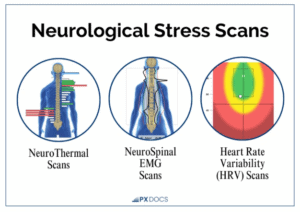
Instead of guessing, INSiGHT scans measure how your child’s nervous system is functioning.
They show:
- Where stress and tension are stuck
- Whether the system is in “fight-or-flight”
- How well regulation is happening
As care progresses, these scans help track real neurological changes — not just symptoms.
Beyond Sleep
When sleep improves, everything else often follows:
- Better digestion
- Fewer illnesses
- Improved mood and behavior
- Better focus and learning
That’s because sleep is foundational — and the nervous system controls it all.
Your Child’s Nervous System Is Ready to Rest
Your child’s struggle to sleep isn’t something they’ll just grow out of.
It’s a nervous system that’s stuck in “go mode,” unable to shift into the state needed for rest and healing.
You’ve done the routines. You’ve created the environment. Those things matter — but they can’t fix neurological interference.
Next Steps
If your child’s sleep struggles aren’t improving, it may be time to look deeper.
Inspire Chiropractic can:
- Assess your child’s nervous system with INSiGHT scans
- Identify areas of dysfunction
- Create a personalized care plan focused on regulation
Your child’s body is designed to sleep, heal, and grow.
Sometimes it just needs the interference removed so it can finally do what it was built to do.
Request an appointment with us today to get started!
Not local to Inspire? Don’t worry! Visit the PX Docs Directory to find a qualified provider near you. https://pxdocs.com/px-docs/
Original Article: https://pxdocs.com/sleep/what-sleep-does-for-a-childs-brain/
PX Docs has established sourcing guidelines and relies on relevant, and credible sources for the data, facts, and expert insights and analysis we reference. You can learn more about our mission, ethics, and how we cite sources in our editorial policy.
- Centers for Disease Control and Prevention. (2025). FastStats: Sleep in children. Retrieved from https://www.cdc.gov/sleep/data-research/facts-stats/children-sleep-facts-and-stats.html
- Zaffanello, M., Pietrobelli, A., Cavarzere, P., Guzzo, A., & Antoniazzi, F. (2024). Complex relationship between growth hormone and sleep in children: Insights, discrepancies, and implications. Frontiers in Endocrinology, 14, 1332114. https://doi.org/10.3389/fendo.2023.1332114
- UC Health. (2020, April 15). Creating better sleep habits to strengthen immunity. https://www.uchealth.com/en/media-room/covid-19/better-sleep-habits-to-strengthen-immunity
- Tadanki, D., Kaza, P. S., Meisinger, E., Syed, A., Johnson, A., Bainbridge, G., Cho, M., Anigbogu, C., & Gupta, G. (2025). Comprehensive review of the impact of maternal stress on fetal development. Pediatric Discovery, 3(3), e70004. https://doi.org/10.1002/pdi3.70004
- Patangia, D. V., Anthony Ryan, C., Dempsey, E., Paul Ross, R., & Stanton, C. (2022). Impact of antibiotics on the human microbiome and consequences for host health. MicrobiologyOpen, 11(1), e1260. https://doi.org/10.1002/mbo3.1260
- Cassoff, J., Wiebe, S. T., & Gruber, R. (2012). Sleep patterns and the risk for ADHD: A review. Nature and Science of Sleep, 4, 73–80. https://doi.org/10.2147/NSS.S31269
- Anna á V. Guttesen, Marcus O. Harrington, Melanie K. Fleming, M. Gareth Gaskell, Scott A. Cairney. (2026). Memory consolidation during sleep: a facilitator of new learning? Volume 221, 30 January 2026, 109320. https://www.sciencedirect.com/science/article/pii/S0028393225002556
- Young-Ah Rho, Jason Sherfey, & Sujith Vijayan. (2023). Journal of Neuroscience. 43 (3) 433-446; https://doi.org/10.1523/JNEUROSCI.1020-22.2022 . https://www.jneurosci.org/content/43/3/433
- Hopkins Medicine. (n.d.). Depression and Sleep: Understanding the Connection. https://www.hopkinsmedicine.org/health/wellness-and-prevention/depression-and-sleep-understanding-the-connection