
Updated on Dec 18, 2025
Author: Dr. Allie Wright
Revised for Inspire Chiropractic by Davis Madole, Reviewed by Dr. Shaheryar Khan DC, CACCP
As a society, we focus heavily on pregnancy announcements, baby showers, and nursery checklists. Those things are exciting—but they’re not the marathon itself.
What often gets missed is how we prepare for birth day and, more importantly, how a mother’s nervous system during pregnancy shapes her baby’s development long before labor begins.
Research clearly shows that maternal stress directly impacts a baby’s developing nervous system. Stress about work, relationships, finances, or even pregnancy itself can influence how a baby’s brain and stress response systems form.
This connection is rarely addressed in conventional prenatal care. Parents are told to “reduce stress,” but not shown how or given tools to measure whether their nervous system is actually regulated.
Your baby’s nervous system is being shaped right now.
Let’s make sure it’s being shaped well.
How Stress Hormones Cross the Placenta
When you experience stress, your body releases cortisol, the primary stress hormone.
Short-term cortisol can be helpful. Chronic stress, however, means cortisol stays elevated—and cortisol crosses the placenta.
That means your baby is exposed to your stress chemistry during critical stages of brain development.
Research shows prenatal stress can:
- Program the baby’s HPA axis (stress response system) to run in high-alert mode
- Affect emotional regulation centers in the brain, such as the amygdala and hippocampus
- Disrupt development of the vagus nerve, which controls digestion, calming, and self-regulation
This helps explain why highly stressed pregnancies are often followed by babies who struggle with feeding, digestion, sleep, and soothing.
This isn’t about occasional bad days. It’s about chronic stress your nervous system can’t fully recover from.
What “Nervous System Regulation” Actually Means
Your Autonomic Nervous System runs everything automatically—breathing, heart rate, digestion, immune response, and stress reactions.
Think of it like a car:
- Sympathetic nervous system = gas pedal (fight-or-flight)
- Parasympathetic nervous system = brake pedal (rest, digest, heal)
In a healthy system, you move smoothly between the two.
Many pregnant moms, however, live with the gas pedal pressed down constantly—work stress, pregnancy anxiety, poor sleep, emotional load. Over time, the brake pedal stops working well.
This state is called sympathetic dominance or dysautonomia.
And because your baby’s nervous system is developing in response to yours, they are learning the same patterns.
The Importance of Nervous System Regulation Before and During Birth
Birth itself is a beautifully timed nervous system sequence.
Early labor depends on the parasympathetic system. When mom feels safe and supported, oxytocin releases effectively, allowing contractions to start and progress smoothly.
As labor moves into pushing, the nervous system must shift gears. The sympathetic system activates briefly to provide strength and power—this is not panic, but purposeful mobilization.
After birth, both mom and baby return to parasympathetic dominance. This supports:
- Baby’s breathing, heart rate, and temperature
- Bonding and breastfeeding
- Postpartum recovery and attachment
For this sequence to work, the nervous system must be regulated and adaptable. No tea, dates, curb-walking, or “tricks” will work well if the nervous system doesn’t feel safe enough to access the brake pedal first.
The Effects of a Dysregulated Nervous System in Birth
When the gas pedal turns on too early, labor can become more difficult.
Stressful environments—bright lights, loud noises, unfamiliar staff, frequent interruptions, or past trauma—activate the sympathetic system prematurely. This can:
- Inhibit oxytocin
- Slow labor
- Increase pain perception
- Lead to more interventions
This stress also affects the baby.
Newborns rely on co-regulation—skin-to-skin contact, warmth, heartbeat, breathing, and feeding—to stabilize their nervous system. When separation happens early, babies show higher stress hormones, unstable vitals, and lower regulation.
The goal isn’t a “perfect” birth. It’s a resilient nervous system that can shift when needed and return to calm afterward.
Prenatal Stress and Baby Outcomes
Research strongly supports what we see clinically.
Studies show babies born to highly stressed mothers have:
- Higher stress reactivity
- More difficulty calming
- Lower Heart Rate Variability (HRV), a marker of poor nervous system regulation
Long-term prenatal stress is linked to higher risk for:
- Anxiety and depression
- ADHD and attention challenges
- Emotional dysregulation
- Changes in brain structure
- Learning difficulties
What matters most isn’t just life circumstances—it’s how well your nervous system can process and recover from stress.
Yet standard prenatal care does not assess or measure this.
What You Can Do Right Now
OB/GYN care is essential and lifesaving—but it doesn’t assess nervous system function.
There is no routine measurement of:
- Maternal stress patterns
- Nervous system regulation
- How stress is affecting baby’s neurological development
This is where Neurologically-Focused Chiropractic Care fills a critical gap.
Measurable Proof—INSiGHT Scans
INSiGHT Scans objectively measure nervous system function using:
- Thermal scanning (stress and autonomic balance)
- Surface EMG (patterns of tension)
- Heart Rate Variability (HRV) (resilience and adaptability)
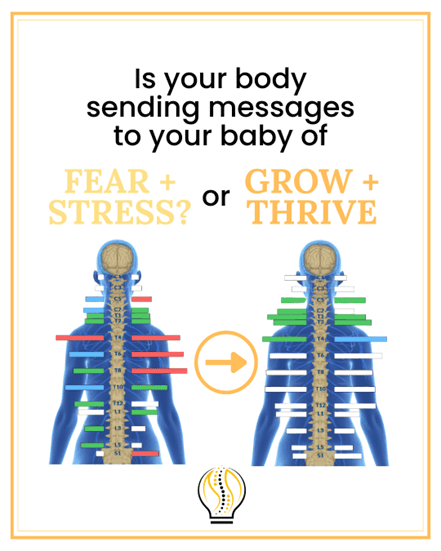
These scans show whether your nervous system is in survival mode or thriving mode.
In practice, we often see:
- Scans improve as care progresses
- Moms report better sleep, energy, and emotional balance
- Babies’ scans reflect mom’s regulation after birth
This is co-regulation in action—regulated moms tend to have regulated babies.
Your Next Step
Request an appointment with us today to get started!
Not local to Inspire? Don’t worry! Visit the PX Docs Directory to find a qualified provider near you. https://pxdocs.com/px-docs/
Start with:
- INSiGHT Scans
- Gentle, Neurologically-Focused adjustments
- Re-scans to track real progress
Earlier in pregnancy is ideal—but it’s never too late to support your nervous system and your baby’s development.
Because how your nervous system feels today helps shape how your baby’s nervous system functions for life.
Original Article: https://pxdocs.com/pregnancy/nervous-system-regulation-before-birth/
PX Docs has established sourcing guidelines and relies on relevant, and credible sources for the data, facts, and expert insights and analysis we reference. You can learn more about our mission, ethics, and how we cite sources in our editorial policy.
SOURCES
- PMC. (2013). Effects of prenatal stress on pregnancy and human development: mechanisms and pathways. https://pmc.ncbi.nlm.nih.gov/articles/PMC5052760/
- PMC. (2024). Affective Touch in Preterm Infant Development: Neurobiological Mechanisms and Implications for Child–Caregiver Attachment and Neonatal Care. https://pmc.ncbi.nlm.nih.gov/articles/PMC11592606/
- National Center for Biotechnology Information. (2023). Neuroanatomy, Neural Tube Development and Stages – StatPearls. https://www.ncbi.nlm.nih.gov/books/NBK557414/
- Flo Health. (2020). Fetal Brain Development Stages: When Does a Fetus Develop a Brain? https://flo.health/pregnancy/pregnancy-health/fetal-development/fetal-brain-development
- Stony Brook Medicine. (2025). Cortisol Explained: Why the “Stress Hormone” Isn’t Always the Enemy. https://health.stonybrookmedicine.edu/cortisol-explained-why-the-stress-hormone-isnt-always-the-enemy/
- Oregon Health & Science University – Moore Institute. (2020). Stress and the Placenta | OHSU. https://www.ohsu.edu/school-of-medicine/moore-institute/stress-and-placenta
- PMC. (2022). Maternal prenatal cortisol programs the infant hypothalamic–pituitary–adrenal axis. https://pmc.ncbi.nlm.nih.gov/articles/PMC9743740/
- Neuroscience News. (2020). Your Amygdala Gets Bigger If You’re Anxious and Depressed. https://neurosciencenews.com/brain-size-depression-anxiety-16769/
- Frontiers in Neuroscience. (2021). A Review on the Vagus Nerve and Autonomic Nervous System During Fetal Development: Searching for Critical Windows. https://www.frontiersin.org/journals/neuroscience/articles/10.3389/fnins.2021.721605/full
- University of California, San Francisco. (2017). Archive: Stress in Pregnancy Linked to Changes in Infant’s Nervous System, Less Smiling, Less Resilience | UC San Francisco. https://www.ucsf.edu/news/2017/11/409146/stress-pregnancy-linked-changes-infants-nervous-system-less-smiling-less
- PMC. (2009). Neonatal Physiological Regulation is Associated With Perinatal Factors: A Study of Neonates Born to Healthy African American Women Living In Poverty. https://pmc.ncbi.nlm.nih.gov/articles/PMC2800796/
- Nature. (2024). Brain structural and functional outcomes in the offspring of women experiencing psychological distress during pregnancy | Molecular Psychiatry. https://www.nature.com/articles/s41380-024-02449-0